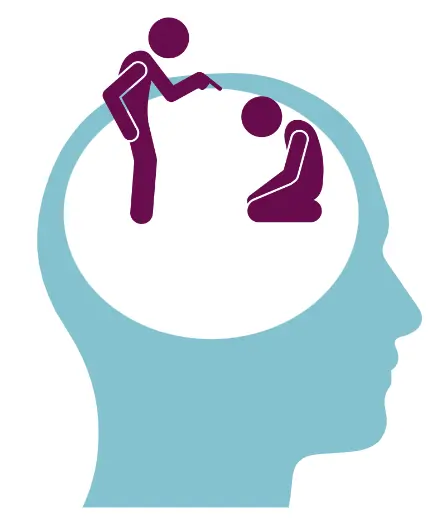
A lot of well‑meaning but misinformed people spread notions along the lines of “Slay your inner dragons,” “Conquer your saboteurs,” “Kill the ANTs,” or “Ego is the enemy.” This language sounds fierce and empowering, but it quietly sets you up for an inner civil war. When you relate to your mind as a battlefield full of bad parts that must be defeated, you’re practicing internal colonization, not healing. You’re taught to distrust your own nervous system, whack-a-mole anything that feels inconvenient, and confuse self‑violence with Self‑leadership.
Those “dragons” and “saboteurs” are usually protective parts running survival code based on your history, culture, and physiology. The anxious planner who won’t let you rest? Probably a part that learned early on that vigilance and a carefully planned step-by-step kept you safe. The inner critic who shreds your work? Often a protector that believes shaming you first will prevent harsher judgment from others. The numbed‑out, scrolling‑for‑hours part? A shutdown protector that figured out that going offline was the only way to keep the pain away. When we attack these parts, we’re attacking the truly helpful roles and tactics that once kept us alive.
Similarly, the catchy advice to “Kill the ANTs” (automatic negative thoughts) treats thoughts like vermin infesting a clean house. But thoughts don’t just fall from the sky; they emerge from your parts, often based on your state. In a threatened, mobilized physiology, some parts will naturally (helpfully) scan for danger and worst‑case outcomes. In shutdown, typically parts will tell hopeless, checked‑out stories. Trying to exterminate “negative thoughts” without tending to the body state (and the protective parts generating them) is like yelling at the fire alarm instead of tending to the fire.
“Ego is the enemy” takes the same fight‑with‑your‑self logic and smuggles it into spiritual and leadership spaces. What many people call “ego” are often parts that care deeply about belonging, dignity, impact, and not being humiliated again. When spirituality or growth work is built on ego‑bashing, you end up with a refined form of self‑rejection: parts that want visibility, safety, or recognition are shamed as “unenlightened” instead of listened to. That’s a trauma‑amplifying loop, and definitely not a path to healing and wholeness.
A parts‑based, trauma‑informed, neurodiversity‑affirming view starts from a different premise: all parts are welcome, even the ones whose tactics you wish to update. Your inner critic is not a dragon to slay; it’s a part that needs context, appreciation for what it has been trying to prevent, and new options. Your “procrastinator” is not a saboteur; it’s a throttle and a brake, trying to protect your system from overwhelm, shame, or impossible demands. Your “ego” isn’t the enemy; it’s a part (or a bunch of parts) trying to negotiate needs for safety, status, and connection in a world that has often been harsh… And in a biological spacesuit that shifts its physiological states the best it can. What does that mean? Read on.
This approach also takes your biology seriously. I like to call the body the “biological spacesuit.” Parts don’t show up in a vacuum; they pop up to take center stage in your biological spacesuit depending on a lot of factors: Is your body rested? What is your brain health like (from physical dents and dings to which brain systems are typically active)? Genetics? Epigenetics? Microbiome? Past learnings (including what we learned to tag “threat” vs. “safe”)?
One of the first aspects like to I share is physiological state. According to polyvagal theory there are 7 states, of which we consider the main states: GREEN, YELLOW, and RED. Though the state will affect sweeping shifts within the biological spacesuit (e.g. Is the immune system up and running? Is the smarty pants brain getting lots of oxygen?), in this post I want to discuss (briefly) what it means for your parts. In GREEN (the physiology of safety and connection), parts can shine at what they do best, soften, or even step back because your body is broadcasting “We’re safe enough now.”
For example, there’s a common part I jokingly call the “Oooh!” part because it loves cool ideas and being creative. In GREEN this part is truly a moral booster to all around. In YELLOW (mobilized, threat‑based physiology), parts will understandably show up with helpful tactics to protect you. Tactics, of course, that stem from an active defense mode. For example, if you tend to have the supportive, harmony loving part (a common personality part) center stage, it may decide it’s best to go along with what everyone else is suggesting. If you tend to have the bossypants, commander part center stage, it may angrily start barking order at others or even steamroll over them. You can see that here:
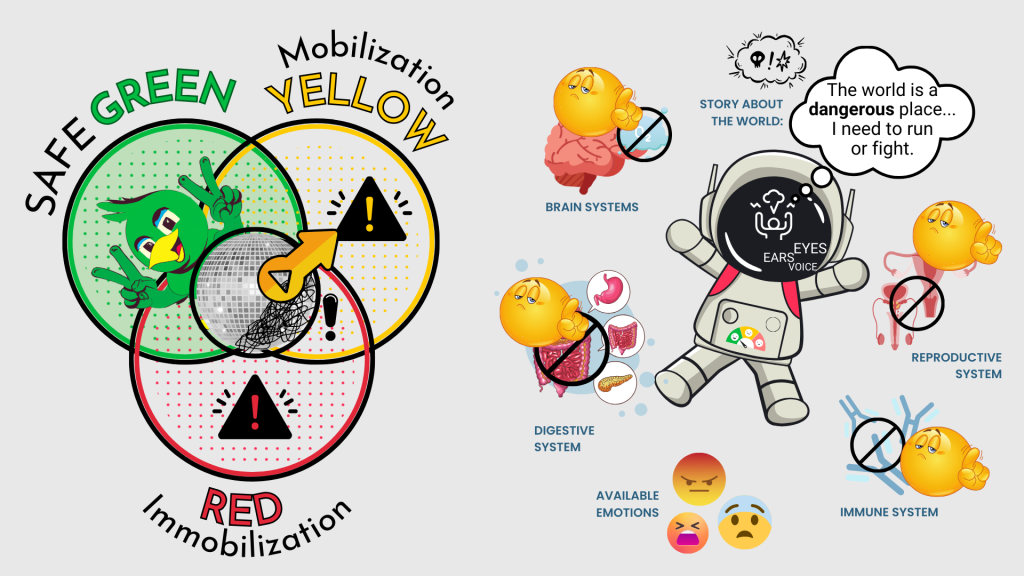
In RED (shutdown), this numbing physiology leads to parts spacing‑out and saying “I don’t care anymore.” Parts are doing damage control in the face of a full body hopelessness. Labeling parts as “bad” or “enemies” just pushes them into the shadows, where they have to shout louder or act more extremely to get your attention. They won’t give up on trying to help you and something their help is more aptly termed “help” — they think they are helping but it’s an overall epic fail. Instead of whack-a-moling these (always) well intentioned parts, it’s better to get to know them, what their concerns are, and work with them to shift their “helpful” roles back to truly helpful and resourceful roles that they love.
Instead of “slay, conquer, kill,” we can switch to “listen, understand, renegotiate.” Curiosity instead of combat. Conversation instead of colonization. You don’t have to like how a part behaves to treat it as fundamentally pro‑you. You can say, “I get that you’re terrified of criticism, and that’s why you keep trashing my work before anyone sees it. That probably saved me at some point. THANK YOU.” Then seek to understand this part’s concerns and give this part an update (e.g. “We’ve got this!”), so it feels good about giving up this “helpful” role.
I like to say “Inner teamwork makes the dream work.” This inner team is guided by True Self (insert any term you like here). Internal Family Systems call this inner leadership Self Leadership, as there is a “part that’s not a part” called Self / Self Energy.
When we stop spreading “slay your dragons” advice, we stop teaching people that the only way to grow is to declare war on themselves. We make room for a model where symptoms are signals, protectors are allies in disguise, and every part has a story that makes sense when you know the context. That doesn’t mean we romanticize or condone harmful behaviors; it means we stop treating our own nervous systems as the enemy. The work is not to kill off parts, but to welcome, understand, and update them (in partnership with them vs. forcing) so they don’t have to scream, sabotage, or shut you down to keep you safe.
If you want to retire the “Conquer your inner enemy” metaphors, take a stance of internal amnesty: all parts welcome, all strategies understandable in light of what you’ve been through, and all of them eligible for renegotiation. Sure it’s not as catchy as “Slay the dragon” on a T‑shirt. But it’s far more compatible with how human minds and bodies actually work—and far kinder to the person you’re going to be living with for the rest of your life: you.
References:
- Schwartz, R. C. (1995). Internal Family Systems Therapy. Guilford Press.
- Schwartz, R. C., & Sweezy, M. (2019). Internal Family Systems Therapy (2nd ed.). Guilford Press.
- Porges, S. W. (2011). The Polyvagal Theory: Neurophysiological Foundations of Emotions, Attachment, Communication, and Self‑Regulation. W. W. Norton & Company.
- Siegel, D. J. (2012). The Developing Mind: How Relationships and the Brain Interact to Shape Who We Are (2nd ed.). Guilford Press.
- Neff, K. (2011). Self‑Compassion: The Proven Power of Being Kind to Yourself. William Morrow.
- Gilbert, P. (2010). Compassion Focused Therapy: Distinctive Features. Routledge.
- Van der Kolk, B. (2014). The Body Keeps the Score: Brain, Mind, and Body in the Healing of Trauma. Viking.