People still spread notions along the lines of “You’re just an introvert,” or “That’s just your personality style,” or “I am X personality type.” These sound tidy and scientific, but they leave out most of what’s actually driving who shows up in the room: your parts, your nervous system, and your history. When we pretend a person is a single, fixed trait profile, people end up feeling doomed by their label instead of curious about their inner ecosystem.
Classic trait models like the Big Five do a decent job describing patterns (“often organized,” “usually anxious”), but description is not explanation. Traits are averages over time, not living beings. What we actually experience from the inside is a shifting cast of inner characters: perhaps the commander part, the relatable part, the supportive / harmony-seeking part, the watchful part, and so forth. These are parts — semi‑autonomous sub‑personalities with their own needs, fears, memories, and strategies… Their own helpfulness/”helpfulness” if you will. (Parts are always trying to be helpful, however sometimes they are not actually beig helpful, hence “helpful.”)
Internal Family Systems (IFS) takes this seriously. Instead of assuming “I am anxious,” it asks, “Which part of me is anxious, and what is it trying to protect?” In this view, much of what trait theory calls “neuroticism” may just be a hard‑working protector who learned that constant scanning and worrying was the safest option available at the time. Same with “agreeableness”: sometimes it’s genuine warmth; sometimes it’s a part terrified of conflict.
Then there’s physiology. The exact same part will look wildly different in different nervous system states. A social, fun, moral-boosting part in a grounded, regulated state might show up as warm extraversion, yelling “Oooh! I love it,” at all the cool stuff. Put that same part into a threat state — heart pounding, gut clenched, neuroception screaming “unsafe” — and it may flip into yelling and making personal attacks on others. What gets scored as a “stable trait” is often just a part’s most practiced survival choreography, as showcased in the body’s physiological home base.
When you use your X-Ray vision to size up your physiology (as GREEN, YELLOW, RED, or a blend), it’s helpful ascertain (1) the state your body is in, (2) how smoothly your body shifts between states, (3) what your physiological home base is, and (4) which parts pop up center stage to help/”help” you when your suit is in that state.
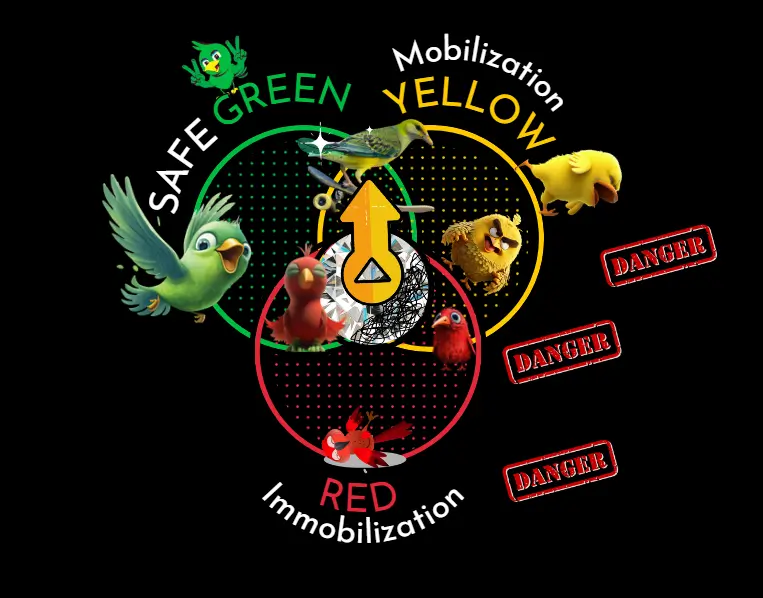


After chronic stress or overwhelming events, certain parts get exiled (the tender, spontaneous, vulnerable ones) and others get promoted to full‑time management (the hyper‑vigilant critic, the numbing strategist, the overachiever). From the outside, this can look like a personality style: “She’s just controlling,” “He’s avoidant,” “They’re so intense.” From the inside, these are exhausted protectors doing the best they can with the physiology and history they’ve got. In response to big stressful and traumatic events, parts often pick up a new role or standard operating procedure (S.O.P.). I like to call this a shield. This makes it very clear: It’s not that we don’t like our parts. Sometimes we don’t like the shields they have picked up.
Modern personality science is already moving away from the idea of rigid, context‑free traits and toward dynamic systems: shifting states, feedback loops, patterns over time. This opens the door to a much more compassionate and productive view: your “personality” is not a prison (or life sentence), it’s a living, adaptive system of parts, embedded in a body, responding to real conditions, and all of your parts are just trying to help! (Always!)
This doesn’t mean trait or “style” assessments are useless. They’re a helpful map at 30,000 feet. But maps are not the terrain. If you want better internal and external relationships, you have to check out the actual terrain with curiosity, compassion, respect, and patience. Go down into the forest. Meet the actual parts, understand how they believe they are helping, what they’re protecting, and build a new relationship with them.
So instead of, “I’m just an anxious introvert,” try: “I have parts that get anxious, especially when my nervous system doesn’t feel safe.” That tiny shift moves you from a fixed identity to a relationship. And relationships can heal, renegotiate, and grow.
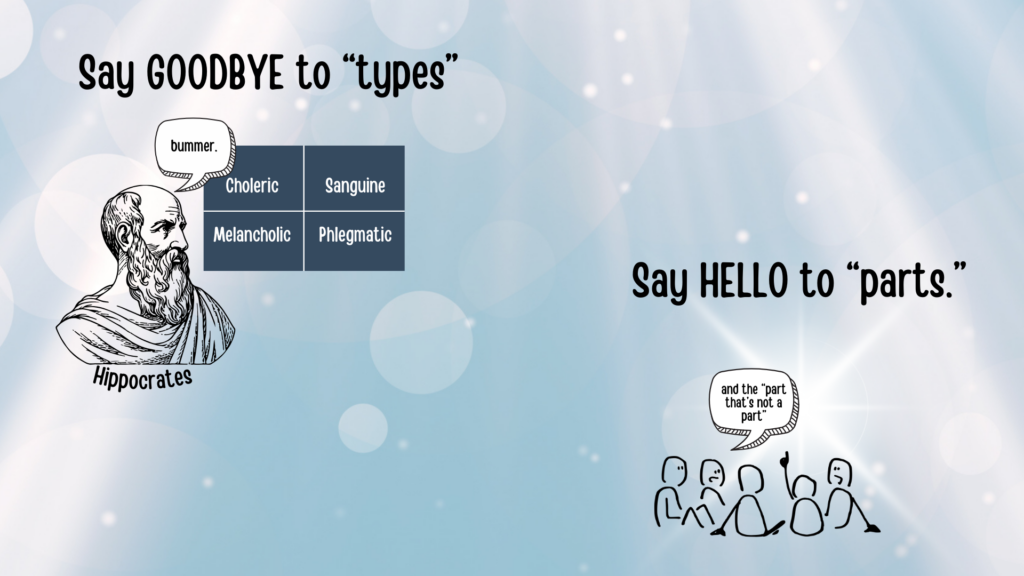
These days, smart leaders and educators are not sorting humans into tidy boxes or fixed “types” that you’re supposed to squeeze yourself into. We’re working from a trauma-informed, neurodiversity affirming lens that assumes you are made of many wise, protective, creative parts — some loud, some quiet, some that make total sense, and some you might wish would just go away. Instead of asking “Which category am I?” we get curious about which parts are showing up right now, what nervous-system state they’re in, and what they’ve been through that makes their strategy make sense (to them). All parts are welcome at the table: the driven one, the shutdown one, the people-pleaser, the rebel, the “too much,” the “too sensitive.” You don’t have to edit yourself down to fit a model; we adapt the model to fit your actual, living, learning system.
Personality isn’t static. It’s a dynamic community of parts, dancing within physiological states and learning to be helpful based on experience. When we see that, we stop pathologizing who we are — and start collaborating with our internal cast of characters.
References:
- McAdams, D. (1992). The five-factor model in personality: A critical appraisal. Journal of Personality.
- Fleeson, W., & Jayawickreme, E. (2015). Whole Trait Theory. Journal of Research in Personality.
- Fajkowska, M. (2016). Personality Traits: Hierarchically Organized Systems. Journal of Personality.
- Sosnowska, J., Kuppens, P., De Fruyt, F., & Hofmans, J. (2019). A dynamic systems approach to personality. Personality and Individual Differences.
- Kuper, N., Modersitzki, N., Phan, L. V., & Rauthmann, J. (2020). The dynamics, processes, mechanisms, and functioning of personality. British Journal of Psychology.
- Geukes, K., van Zalk, M. H. W., & Back, M. D. (2018). Understanding personality development: A state process model. International Journal of Behavioral Development.
- Back, S. N., Flechsenhar, A., Bertsch, K., & Zettl, M. (2021). Childhood traumatic experiences and dimensional models of personality disorder. Current Psychiatry Reports.
- Schwartz, R. C. (1995). Internal Family Systems Therapy. Guilford Press.