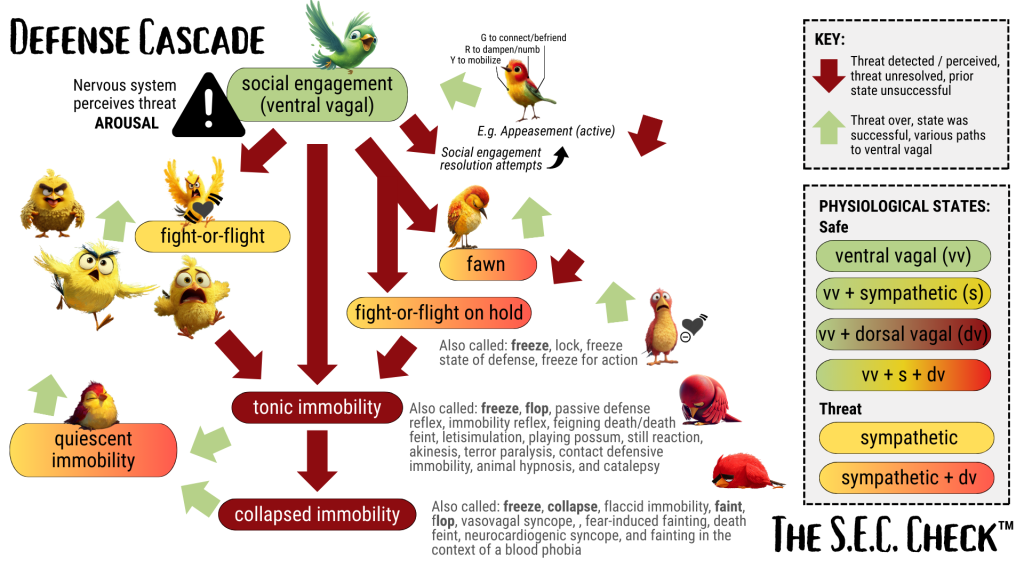
The defense cascade describes the predictable, biologically conserved sequence through which the nervous system responds to perceived threat, moving from mobilization toward immobilization as danger escalates or becomes inescapable. While this cascade is well established in ethology, trauma science, and neuroscience, it is often discussed separately from polyvagal theory (PVT), which emphasizes autonomic state, neuroception, and social engagement. In this post, I integrate the defense-cascade literature with the color-based polyvagal framework to clarify how different survival responses unfold and how the nervous system ultimately transitions from defense back into restoration and healing.
In the defense cascade, the sequence is: arousal → fight/flight → freezing (fight/flight on hold) → tonic immobility → collapsed immobility → quiescent immobility.
In this post I am adding the colors we use in polyvagal theory (PVT) to the established cascade, but I also want to include appeasement and fawning (not in the cascade). Why did I place these where I did? Per PVT, when cues of safety are ambiguous but not overwhelming, the ventral vagal social engagement system is recruited to inhibit defenses and mediate (or seek) safety through social strategies. Thus, in my estimation fawn/appeasement is best placed after initial arousal but before fight or flight / fight-or-flight on hold (FREEZE).
Items of interest:
- Porges and Porges, appeasement is GYR (an active attempt to befriend a threat) and fawn is passive (shrinking and complying).
- From collapsed/tonic immobility, the defense‑cascade literature explicitly describes a move into quiescent immobility for rest and healing once threat is no longer imminent.
- The most correct usage of the word FREEZE is for fight-or-flight on hold (YELLOW). This term is used to denote other states too — which is why people are often confused. (Please see image above for more info.)
| Cascade | Empirical anchor | Notes |
|---|---|---|
| GREEN → arousal | Safe → arousal | Loss of ventral vagal dominance, hypothalamus activation |
| Social strategy (appease/fawn; GYR/GY) | Ventral vagal social engagement under threat | Attempts to down‑regulate defense socially |
| YELLOW fight/flight | Sympathetic mobilization | Active defense |
| “Fight/flight on hold” | Freezing | Defined as flight/flight put on hold |
| Tonic + collapsed immobility | Dorsal vagal shutdown | Defensive immobilization with fear |
| Quiescent immobility (RY) | Healing/rest immobilization | Shutdown without fear, recovery mode |
References:
- Polyvagal Theory: Current Status, Clinical Applications, and Future Directions Stephen W Porges 2025
- LOVE: AN EMERGENT PROPERTY OF THE MAMMALIAN AUTONOMIC NERVOUS SYSTEM S. Porges 1998
- Polyvagal theory: a journey from physiological observation to neural innervation and clinical insight Stephen W Porges 2025
- The polyvagal theory: phylogenetic substrates of a social nervous system. S. Porges 2001
- Emotion: An Evolutionary By‐Product of the Neural Regulation of the Autonomic Nervous System a S. Porges 1997
- Fundamental challenges and likely refutations of the five basic premises of the polyvagal theory P. Grossman 2023
- Polyvagal Theory: A biobehavioral journey to sociality S. Porges 2021
- Molecular Mechanisms Underlying Pupal Protective Color Switch in Papilio polytes Butterflies S. Yoda, Emi Otaguro, M. Nobuta, H. Fujiwara 2020
- Fear and the Defense Cascade: Clinical Implications and Management K. Kozlowska, P. Walker, Loyola M Mclean, P. Carrive 2015
- Green‐to‐red spectral labeling: A novel polysynaptic retrograde tracing strategy in the marker footprint mouse model Yige Song, Jinyu Zeng, Yunyun Han, Aodi He, Houze Zhu 2025
- Distributed circuits regulating defensive state transitions: freezing, flight and fight C. Borkar, J. Fadok 2024
- Risk of social colours in an agamid lizard: implications for the evolution of dynamic signals Madhura S. Amdekar, M. Thaker 2019
- Immobility reactions under threat: A contribution to human defensive cascade and PTSD E. Volchan, V. Rocha-Rego, A. Bastos, José M Oliveira, C. Franklin, Sonia Gleiser, William Berger, Gabriela Guerra Leal Souza, L. Oliveira, Isabel A David, F. Erthal, M. Pereira, I. Figueira 2017
- Borderline personality disorder and emotion regulation: Insights from the Polyvagal Theory M. Austin, T. C. Riniolo, S. Porges 2007
- Polyvagal Theory: A Science of Safety S. Porges 2022
- Different LED Light Colors Modify Behavior, Physiology, and Hypothalamic CRF and NPY mRNA Expression in Japanese Quail (Coturnix coturnix Japonica) Bassant A. Elbaz, I. Fares, Ali M. Ahmed, Ibrahim M. Hegab 2023
- Integrated cardio-behavioral responses to threat define defensive states J. Signoret-Genest, Nina Schukraft, Sara L Reis, Dennis Segebarth, K. Deisseroth, P. Tovote 2023
- High-contrast yellow-to-green electrochromic and electrofluochromic polyamides bearing triphenylamine fused to quinoxaline aimed for self-adaptive camouflage and explosive sensor Yunlong Zang, Wanan Cai, Minghao Zhai, Zixiang Zheng, Wenbin Zheng, Haijun Niu, Tingting Zhou, Wen Wang 2025
- Asylum-seeking children in shutdown: Neurobiological models K. Kozlowska, Stephen Scher, Helene Helgeland, P. Carrive 2021
- Bifurcated Polymorphic Transition and Thermochromic Fluorescence of a Molecular Crystal Involving Three-Dimensional Supramolecular Gear Rotation Yun-Hsuan Yang, Yu-Shan Chen, Wei‐Tsung Chuang, Jye‐Shane Yang 2024
0 Comments