In polyvagal theory, neuroception is the brain–body system’s pre‑conscious detection of safety, danger, or life-threat from internal bodily cues, other people, and the environment. This detection then automatically shifts autonomic state (ventral vagal/social engagement, sympathetic mobilization, dorsal vagal shutdown) without deliberate awareness or reflection. Porges emphasizes that this is a subconscious risk‑evaluation process built into neural circuits, not a learned, reflective judgment.
Neuroception is the behind‑the‑scenes scanning that is always going on. It’s the “feather‑O‑meter,” if you will:
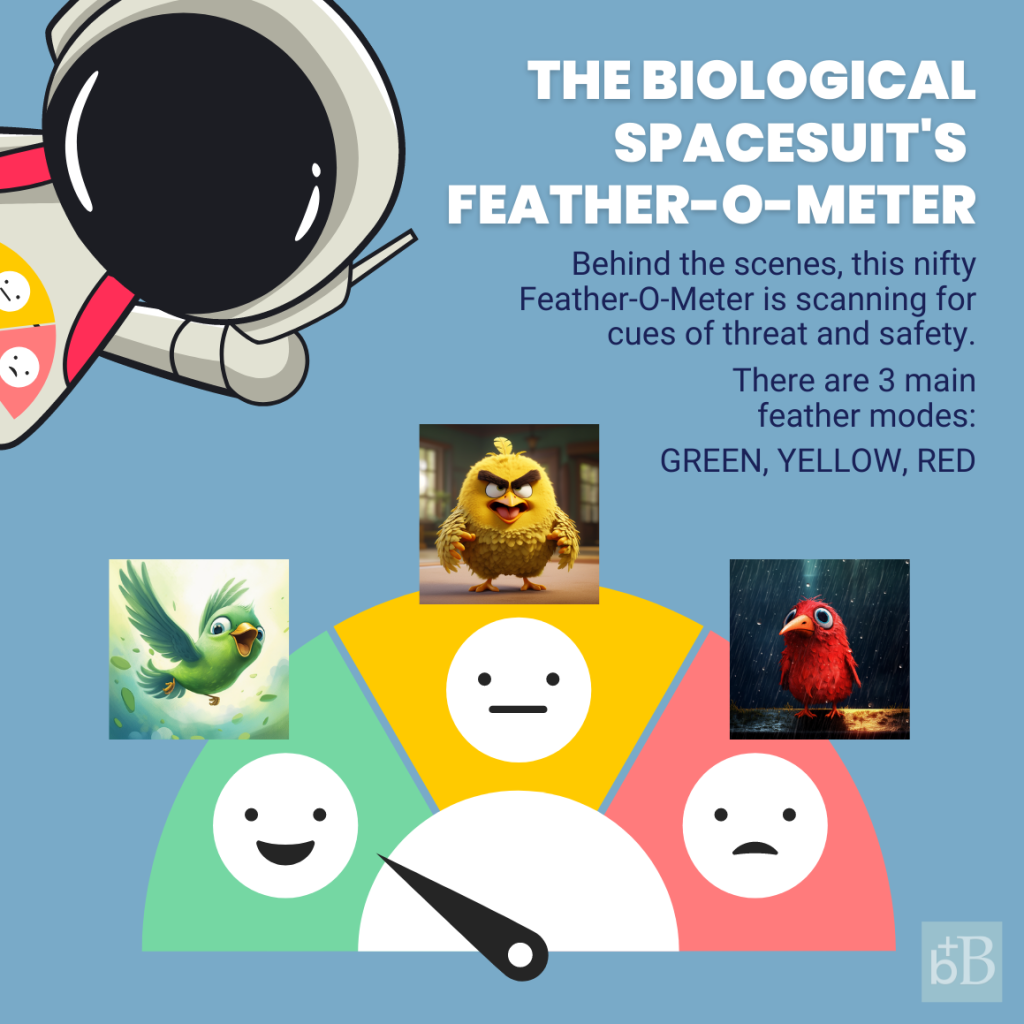
Neuroception sets the bodily and neural context that gives rise to the very early, coarse positive/negative valuation (proto-affect) that later becomes full affect and emotion through interoceptive representation and predictive processing.
The sequence would be:
Sensory input + visceral input + relational cues (input) → Pre‑conscious safety–danger categorization, autonomic shift → Primitive valence/arousal from new bodily state →→ Emotion
The sequence would be: Sensory input + visceral input + relational cues (input) → Pre‑conscious safety–danger categorization, autonomic shift → Primitive valence/arousal from new bodily state →→ Emotion
This sequence can also be mapped as:
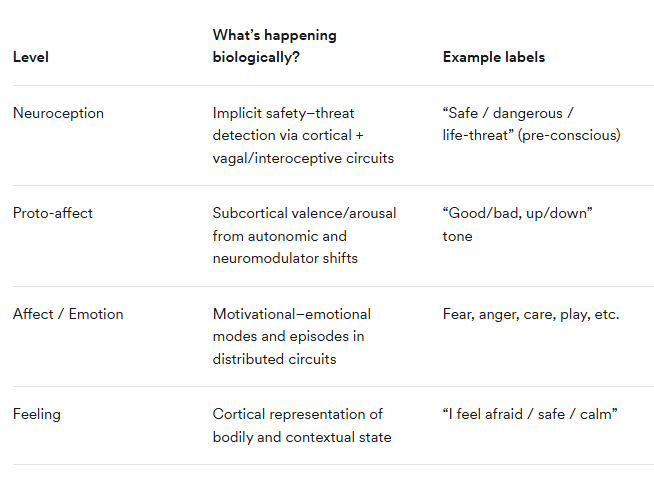
Neuroception → Proto-affect → Affect → Emotion
This is why you might have heard the term “bottom‑up.” These processes are stemming from the bottom of the brain:
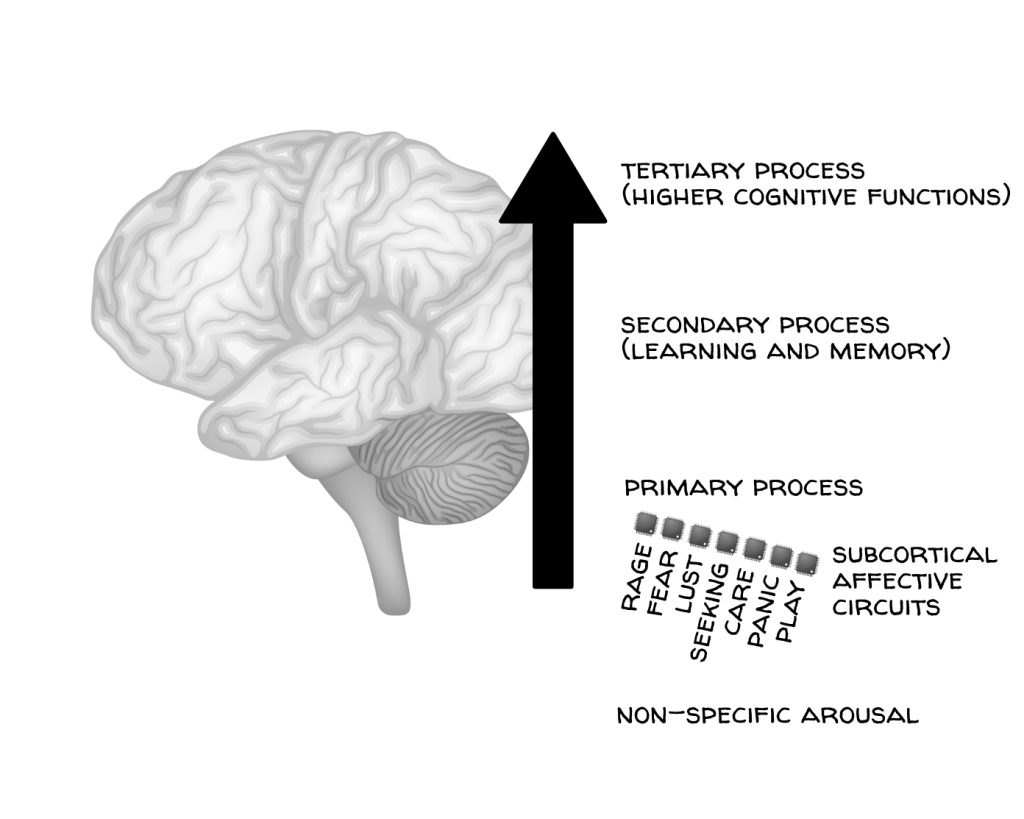
Affective neuroscience studies the neural basis of emotion. It investigates the neural basis of affect, emotion, and feeling, including their generation, regulation, and disruption in health and psychopathology. It focuses on brain circuits (often in subcortical and limbic regions plus prefrontal cortex) that create positive and negative emotional states, motivate behavior, and underlie mood and emotional disorders.
Proto‑affects can be understood as minimal, fast, bodily–neural valuation signals (e.g., very primitive “good for me” / “bad for me” tendencies) that scaffold richer affect and emotion but may not yet be consciously experienced or conceptually categorized as emotions.
In clinical and Pankseppian traditions, affect is a primitive, evolutionarily conserved mental process, rooted largely in subcortical brain systems, that places an organism into a particular motivational–emotional state (e.g., SEEKING, RAGE, FEAR, CARE, PANIC/GRIEF, LUST, and PLAY) that guides behavior and signals how well it’s doing relative to survival “comfort zones.” Such affects can be consciously felt as emotional feelings, but some affective processes may also operate below full awareness.
Emotions are more structured episodes built on top of the affective backdrop. One influential definition reserves “emotion” for relatively short‑lived (seconds to minutes) states that are triggered by a particular object or situation (“that person insulted me,” “that dog is running toward me”) and whose main job is to bias action (fight, flee, approach, comfort, etc.). Emotions involve coordinated changes across appraisal (“what does this mean for me?”), physiology, facial expression, action tendencies, and attention, which unfold over time before they are even consciously labeled. Different theories disagree on how “basic” or universal these states are, but they generally agree that emotions are more organized and situational than raw affect.
Feelings add another layer: they are the subjective, conscious experience of what the body and brain are doing. One broad definition treats a feeling as a mental representation or perception of physiological and contextual states—how hunger, pain, fear, relief, gratitude or well‑being actually feel from the inside. Feelings can arise from emotions (the feeling of fear), from homeostatic needs (hunger, thirst), from pain, drives, social interactions and more. Many authors emphasize that feelings are not the same thing as emotions: feelings are one component of an emotional episode, but there are also feelings that are not emotional at all, and some emotional processes may run with little or no conscious feeling. In short, “feeling“ is the conscious, reportable “what it’s like” aspect of all this; a perception or appraisal of bodily and situational states that may or may not map neatly onto emotion categories.
For those of you that like to follow the steps 1‑by‑1, it would look like this (though, yeah, I cheated and combined a few there in step 4):
- There is an input stage: Visceral and autonomic signals (heart, lungs, gut, etc.) ascend via vagal and spinal pathways to brainstem nuclei (NTS, parabrachial nucleus), hypothalamus, amygdala, and insula. Simultaneously, sensory cues (faces, voices, posture, context) are processed in sensory and social‑brain areas and feed into threat–safety networks.
- Neuroception does its thing: The situation is rapidly categorized as safe, dangerous, or life‑threatening, triggering distinct autonomic patterns (ventral vagal calm–engagement, sympathetic fight/flight, dorsal vagal shutdown, etc.). This evaluation typically occurs before explicit feelings or thoughts about being safe or afraid, and can be wrong (maladaptive threat detection in anxiety, chronic pain, etc.). (If you want to, you can grow your ability to bring perception to neuroception.) The neuroceptive “decision” alters heart rate, breathing, muscle tone, gut activity, endocrine/immune functions, etc. That decision puts the body into a specific physiological state (ventral vagal, sympathetic, dorsal vagal, or a blend thereof, which we like to consider as GREEN, YELLOW, RED, or a blend thereof).
- Generation of proto‑affect from autonomic–interoceptive consequences: This neuroceptive shift of autonomic and bodily state, plus subcortical and brainstem affect‑generating circuits (e.g., hypothalamus, periaqueductal gray, nucleus accumbens, ventral pallidum, and other limbic structures), generates rudimentary valence and arousal signals—proto‑affect. These primary‑process networks release “raw” positive or negative feeling tones (proto-affect) that anticipate survival needs (approach vs avoidance, comfort vs discomfort) and are shared across mammals.
- From proto‑affect to affect to emotion to feeling: Proto-affect comes from very primitive shifts in arousal/valence from brainstem and hypothalamus, neuromodulators, and visceral changes, and may bias the body toward defensive vs exploratory modes without clearly locking into a specific primary system yet. Once a Pankseppian system (affective circuit) like FEAR is engaged, you have a full‑blown primary affective state—an evolutionarily “built‑in” emotion. This can occur entirely subcortically and without any cortical labeling or reflection. Cortical/tertiary processes (PFC, language, autobiographical memory) then interpret and name that FEAR state, embed it in story, morality, self‑concept, etc., and report it as a feeling: “I am afraid…”
Summary:
References:
- Polyvagal theory: a journey from physiological observation to neural innervation and clinical insight Stephen W Porges 2025
- Polyvagal Theory V. Schroeter 2016
- Polyvagal Theory: Current Status, Clinical Applications, and Future Directions Stephen W Porges 2025
- Polyvagal Theory: A Science of Safety S. Porges 2022
- [Polyvagal Theory and Its Clinical Potential: An Overview]. H. Hanazawa 2022
- The Application of the Polyvagal Theory to High Conflict Co‐Parenting Cases Rebecca F. Bailey, D. Dana, Elizabeth Bailey, F. Davis 2020
- Using Polyvagal Theory to Understand Autistic Meltdown Chee Keong Chua 2023
- Autonomic Nervous System Development and its’ Impact on Neuropsychiatric Outcome S. Mulkey, A. du Plessis 2018
- Integrating Polyvagal Theory in Bioenergetic Therapy Arild Hafstad 2025
- Integrating Polyvagal Theory and the Neurodiversity Paradigm for Inclusive Practice Sarah Dwan, Alejandro E. Brice 2025
- Polyvagal Theory: A biobehavioral journey to sociality S. Porges 2021
- The polyvagal perspective S. Porges 2007
- The Covid-19 Pandemic is a Paradoxical Challenge to Our Nervous System: A Polyvagal Perspective S. Porges 2020
- A neurofunctional signature of affective arousal generalizes across valence domains and distinguishes subjective experience from autonomic reactivity Ran Zhang, Xianyang Gan, Ting Xu, Fangwen Yu, Lan Wang, Xinwei Song, Guojuan Jiao, Xiqin Liu, Feng Zhou, Benjamin Becker 2025
- The evolution of sociality and the polyvagal theory J. Doody, G. Burghardt, V. Dinets 2023
- The polyvagal theory: phylogenetic substrates of a social nervous system. S. Porges 2001
- An in-depth analysis of the polyvagal theory in light of current findings in neuroscience and clinical research. Andrea Manzotti, Cristina Panisi, Micol Pivotto, Federico Vinciguerra, M. Benedet, Federica Brazzoli, Silvia Zanni, Alberto Comassi, Sara Caputo, Francesco Cerritelli, M. Chiera 2023
- LOVE: AN EMERGENT PROPERTY OF THE MAMMALIAN AUTONOMIC NERVOUS SYSTEM S. Porges 1998
- The neurobiology of interoception and affect M.J. Feldman, E. Bliss-Moreau, K. A. Lindquist 2024
- Emotion, plasticity, context, and regulation: perspectives from affective neuroscience. Richard J. Davidson, D. Jackson, Ned H. Kalin 2000
- Affective experience in neuroscience and phenomenology: An epistemological analysis of emotions and feelings Davide Perrotta 2025
- Physiological feelings E. Pace-Schott, Marlissa C. Amole, Tatjana Aue, M. Balconi, Lauren M. Bylsma, H. Critchley, H. Demaree, B. Friedman, Anne Elizabeth Kotynski Gooding, O. Gosseries, T. Jovanović, Lauren A. J. Kirby, K. Kozlowska, S. Laureys, Leroy Lowe, K. Magee, Marie-France Marin, A. Merner, Jennifer L. Robinson, Robert C. Smith, Derek P. Spangler, M. Overveld, M. VanElzakker 2019
- Reconciling cognitive and affective neuroscience perspectives on the brain basis of emotional experience J. Panksepp, R. Lane, M. Solms, Ryan Smith 2017
- The neurobiological basis of affect is consistent with psychological construction theory and shares a common neural basis across emotional categories D. Gündem, Jure Potočnik, F. De Winter, Amal El Kaddouri, Daphne Stam, R. Peeters, L. Emsell, S. Sunaert, L. Van Oudenhove, M. Vandenbulcke, Lisa Feldman Barrett, J. van den Stock 2022
- The subjective experience of emotion: a fearful view Joseph E LeDoux, S. Hofmann 2018
- Using the theory of constructed emotion to inform the study of cognition-emotion interactions G. Dreisbach 2022
- Understanding Emotions: Origins and Roles of the Amygdala G. Šimić, M. Tkalcic, Vana Vukić, D. Mulc, Ena Španić, M. Šagud, F. Olucha-Bordonau, M. Vukšić, Patrick R. Hof 2021
- Emotion, plasticity, context, and regulation: perspectives from affective neuroscience. Richard J. Davidson, D. Jackson, Ned H. Kalin 2000
- The Emotion Process: Event Appraisal and Component Differentiation. K. Scherer, A. Moors 2019
- Affective neuroscience of the emotional BrainMind: evolutionary perspectives and implications for understanding depression 2010
- The Theory of Constructed Emotion: More Than a Feeling Lisa Feldman Barrett, S. Atzil, Eliza Bliss-Moreau, Lorena Chanes, M. Gendron, Katie Hoemann, Yuta Katsumi, Ian R Kleckner, Kristen A. Lindquist, Karen S. Quigley, Ajay B. Satpute, Eli Sennesh, Clare Shaffer, Jordan E. Theriault, Michele Tugade, Christiana Westlin 2025
- The neurobiology of interoception and affect M.J. Feldman, E. Bliss-Moreau, K. A. Lindquist 2024
- A higher-order theory of emotional consciousness Joseph E LeDoux, Richard Brown 2017
- Investigating Emotions as Functional States Distinct From Feelings R. Adolphs, D. Andler 2018
- Perspectives from affective science on understanding the nature of emotion E. Fox 2018
- At the interface of the affective, behavioral, and cognitive neurosciences: Decoding the emotional feelings of the brain J. Panksepp 2003
- Consciousness and the varieties of emotion experience: a theoretical framework. J. Lambie, A. Marcel 2002
- Affective neuroscience. Emotion from “basic emotion” approach Ovidiu Mihail Postolache 2024
- What are ‘positive’ affect and emotion? M. Shiota, D. Sauter, P. Desmet 2021
- Selected Principles of Pankseppian Affective Neuroscience K. Davis, C. Montag 2019