A portfolio vision defines what the portfolio (which will consist of set of components, e.g. projects), should achieve for the organization. The vision states the long-term purpose of the portfolio, such as supporting specific strategic domains, balancing growth and resilience, or learning in emerging areas. This vision is derived from corporate vision and strategy and provides the directional anchor for all subsequent portfolio artifacts.
Portfolio goals then specify high-level qualitative outcomes that the portfolio should deliver. These goals translate the vision into thematic aims, such as increasing revenue share from digital offerings, strengthening capabilities in particular value streams, or maintaining an agreed balance between exploitative and exploratory initiatives. Goals describe the intended contribution of the portfolio to corporate strategy without yet assigning metrics or timelines.
Portfolio objectives convert goals into measurable and time-bound targets. These objectives define expected performance ranges for dimensions such as value contribution, risk exposure, innovation mix, and capability development over specific planning horizons. Research on project portfolio management emphasizes that objectives guide alignment and balance and that they act as reference points for subsequent prioritization and adjustment of portfolio components.
The Portfolio Strategic Plan follows and connects objectives with high-level choices about portfolio composition and evolution. This plan describes which strategic themes and business areas the portfolio will emphasize, which types of components it will include, and how it will respond to environmental and strategic shifts. At this stage, portfolio management literature positions the prioritization model as an internal component of the plan, because the plan must specify how initiatives will be ranked, selected, and adjusted to support strategic intent.
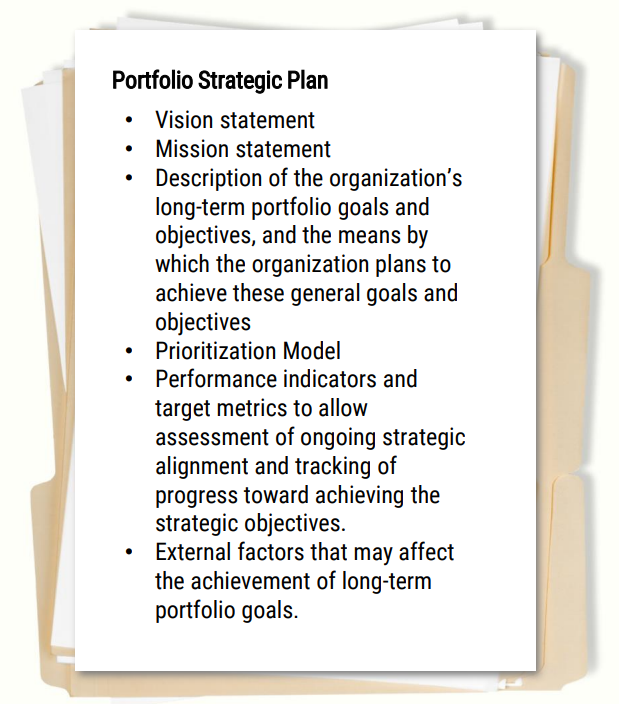
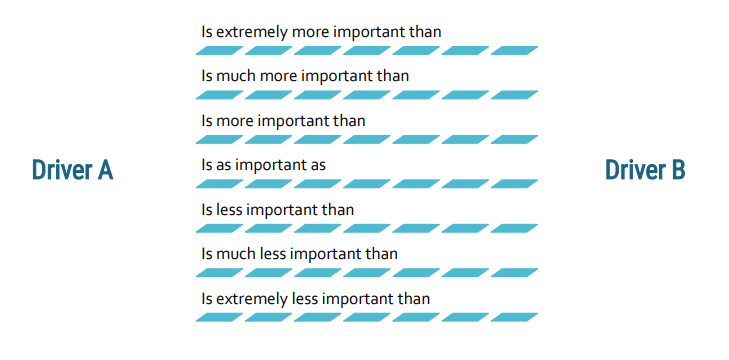
The prioritization model within the Portfolio Strategic Plan formalizes decision criteria and weights. Multi-criteria decision-making tools such as Analytic Hierarchy Process (AHP), fuzzy AHP, or AHP–Goal Programming hybrids are typically used here to derive weights from expert judgment, link criteria to strategy, and produce consistent rankings of candidate projects, programs, or business model initiatives. Studies across IT, software, public administration, and community development show that AHP-based models support transparent alignment with strategic objectives, reduce ad hoc power-based decisions, and handle heterogeneous qualitative and quantitative criteria.
AHP is a structured multi-criteria decision-making method that helps compare alternatives when several, often conflicting, factors matter. AHP first breaks a decision down into a hierarchy with the overall goal at the top, followed by criteria and sub-criteria, and alternatives at the bottom. Decision makers then perform pairwise comparisons, judging the relative importance of one element versus another using a numerical scale, which converts qualitative preferences and expert judgments into quantitative priority weights. AHP checks the internal consistency of these judgments and aggregates the resulting weights through the hierarchy to produce an overall priority score for each alternative, supporting transparent and logically organized decisions in complex settings. Click here for a step by step look at AHP.
AHP example:
Scorecard example:
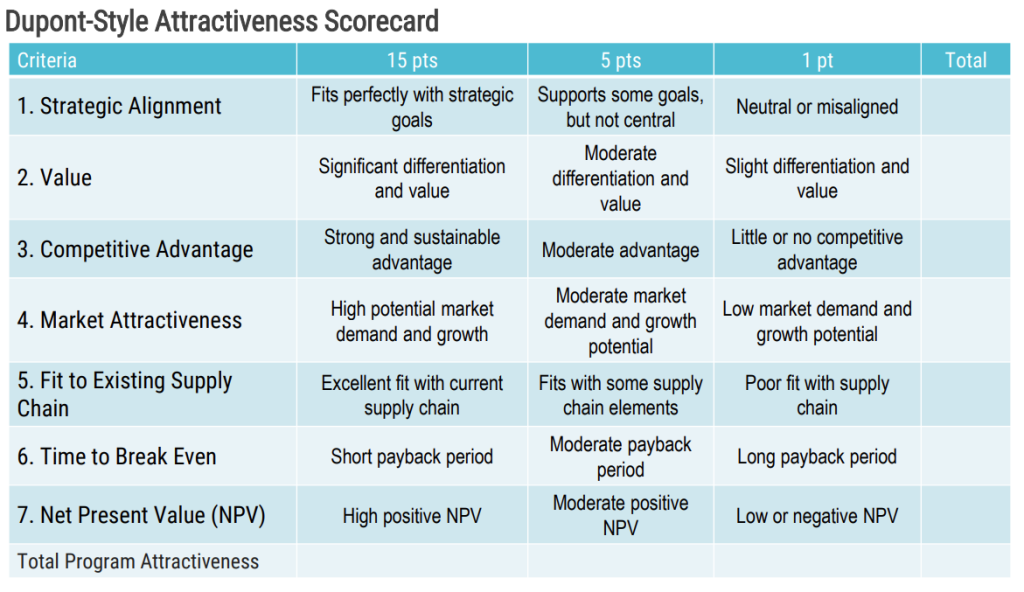
For more on prioritization models, read this post.
The question as to what the Portfolio Business Model should look like arises after strategic directions and prioritization principles are defined. Conceptual work on business model portfolios and formal control frameworks indicates that strategy and objectives first specify where and how to compete, and that business model portfolio design then explores alternative enterprise- and portfolio-level models that could realize these choices. In practice, the Portfolio Strategic Plan will usually spur the creation and refinement of the portfolio-level business model, because the plan sets target domains, balance requirements, and synergy expectations that a structural business model needs to implement. To read more about portfolio business models, check out this post and this post.
A portfolio-level business model then describes how the set of business models or major value streams, taken together, creates and captures value. This portfolio business model specifies complementarities, shared platforms, and resource configurations that support the strategic intent expressed in the Portfolio Strategic Plan. Research on business model portfolios highlights that this level includes both conceptualization, where alternative configurations are generated and evaluated, and implementation, where interdependencies and shared assets are actively managed.
The Portfolio Charter comes next as the formal authorization and structural definition of the portfolio. The charter restates the portfolio vision, goals, and objectives in concise terms, and covers some new key areas as well (see image below). The portfolio structure specifies which kinds of components belong to the portfolio (projects, products, programs, sub-portfolios), which strategic categories or business units they fall under, and what sits outside the boundary. If included, governance sections in the charter define decision rights, escalation paths, review cadences, and links to corporate strategy and business model management bodies.
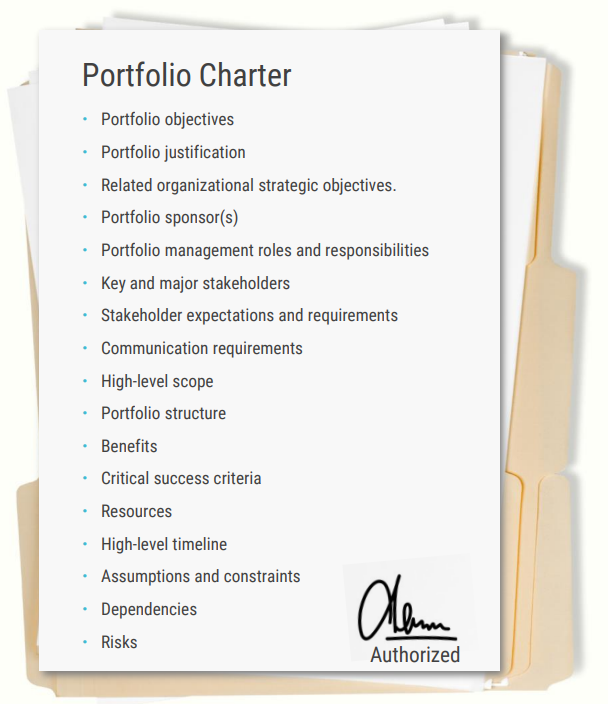
The charter also encodes high-level principles drawn from the Portfolio Strategic Plan and the portfolio business model. These principles may include desired balance targets, dependency rules between business models, and guardrails for resource allocation. Practice-oriented portfolio research shows that such structural and procedural definitions support consistent application of prioritization models, repeated alignment checks, and responsive adaptation when conditions change.
The Portfolio Roadmap follows (after the charter) and provides a time-phased view of portfolio execution. The roadmap sequences major initiatives, business model experiments, capability builds, and decommissioning activities in alignment with objectives, strategic themes, and the portfolio business model. Roadmapping research at the front end of innovation shows that integrating technology, capability, and project views into a single temporal map helps connect long-term intent with near-term decisions and reveals interdependencies and bottlenecks early. For a good example of a digital roadmap, click here.
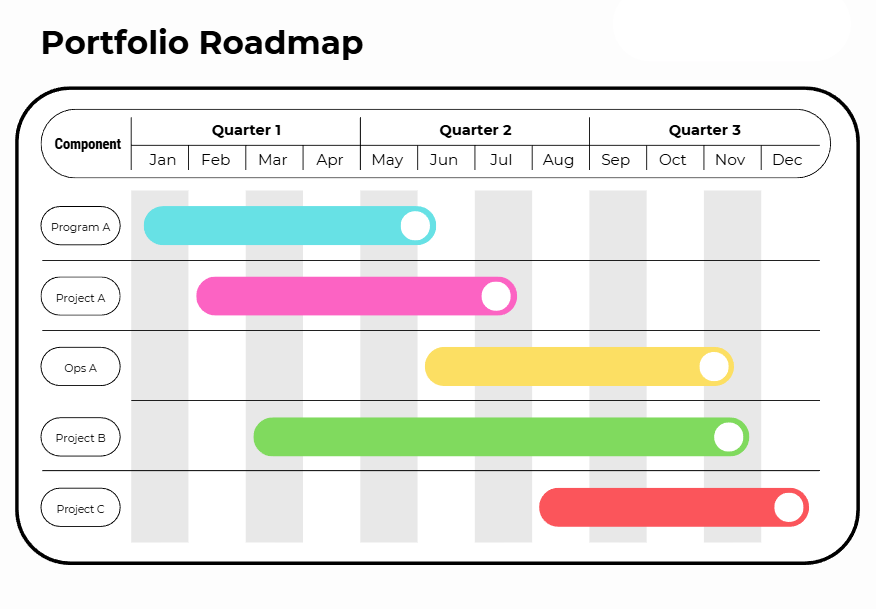
AI-enhanced analytics and automation complement these tools across several steps. During prioritization and roadmap design, machine learning models provide forecasting for value, risk, and capacity utilization, while AHP or ANP remains the mechanism to encode strategic preference structures and derive criteria weights. In continuous operation, AI-driven dashboards monitor portfolio performance, detect deviations from objectives, and support periodic reapplication of prioritization models as part of rolling wave planning and roadmap adjustment.
Across this ordered sequence, the artifacts and tools form an integrated system. Portfolio vision, goals, and objectives provide the directional WHATs. The Portfolio Strategic Plan, with its embedded prioritization model, expresses the broad HOW and defines decision rules. The portfolio-level business model describes structural value creation logic that responds to this plan. The Portfolio Charter formalizes scope, structure, and governance so that these design choices can operate in practice. The Portfolio Roadmap then translates all preceding elements into a coherent temporal path, refined over time with inventories of work, AHP-based models, optimization techniques, and AI-supported analytics.
References:
- “Bridging strategic planning and business model management – A formal control framework to manage business model portfolios and dynamics” – Dietfried Globocnik, Rita Faullant, Zulaicha Parastuty
- “The business model portfolio as a strategic tool for value creation and business performance” – Peter Westerveld, Erik Fielt, Kevin C. Desouza, Guy G. Gable
- “Linking Organization’s Strategy and Strategic Planning with Portfolio Management” – Alfonso Bucero
- “Practices, projects and portfolios: Current research trends and new directions” – Stewart Clegg, Candice A. Killen, Christopher Biesenthal, Shankar Sankaran
- “Development of a managerial tool for prioritization and selection of portfolio projects using the Analytic Hierarchy Process methodology in software companies” – Rodrigo Kaiser, Adriano Heemann Futami, Luciana Dalla Valentina, Marco Aurélio de Oliveira
- “Using Analytic Hierarchy Process as a Decision-Making Tool in Project Portfolio Management” – Darius Danesh, Michael J. Ryan, Ali A. Abbasi
- “Prioritization of project proposals in portfolio management using fuzzy AHP” – Kajal Chatterjee, Sheikh A. Hossain, S. Kar
- “Using the deterministic approach model for project portfolio selection problem (PPSP) solutions” – A. Mogbojuri, O. I. Olanrewaju
- “Comparative Analysis of Prioritization Model Between AHP (Analytic Hierarchy Process) and ANP (Analytic Network Process) for Project Portfolio Management SI/IT Surabaya City Government” – Rita Sari, Ima Kurniastuti, Endang Sulistiyani
- “Use of the Analytic Hierarchy Process and Selected Methods in the Managerial Decision-Making Process in the Context of Sustainable Development” – Jarmila Štofková, Matej Krejnus, Katarína Štofková, Peter Malega, Vladimíra Biňasová
- “Strategic Portfolio Optimization: Balancing Agile, Lean Six Sigma, and AI-Augmented Resource Allocation Models” – [Author names not available in provided excerpt]
- “The portfolio planning, implementing, and governing process: An inductive approach” – Nitish Gupta, Hyunkyu Park , Rob Phaal