An enterprise-level business model converts strategic choices into how the enterprise will create, deliver, and capture value. Strategy tells the organization which customers and needs to prioritize and which competitive stance to adopt, and the subsequent the business model lays out the interdependent activities and mechanisms that make the strategic intent feasible.
In an aligned and similar way, the portfolio management practice often needs to express how multiple, (often interdependent) business models together contribute to its strategic objectives. Each model in the portfolio has its own value logic and target segment, but the portfolio is typically managed as a system with complementarities, diversification, and sensing functions that support corporate goals.
If your portfolio lives within a department, you might not see this level of complexity. Perhaps you are managing an IT Grow-The-Business Portfolio. In this case, you likely would need to put together a single portfolio-level business model.
But let’s take a moment to consider the typical sunray diagram that we would use to showcase how a portfolio will take the organization from its current AS-IS state to its future TO-BE state:
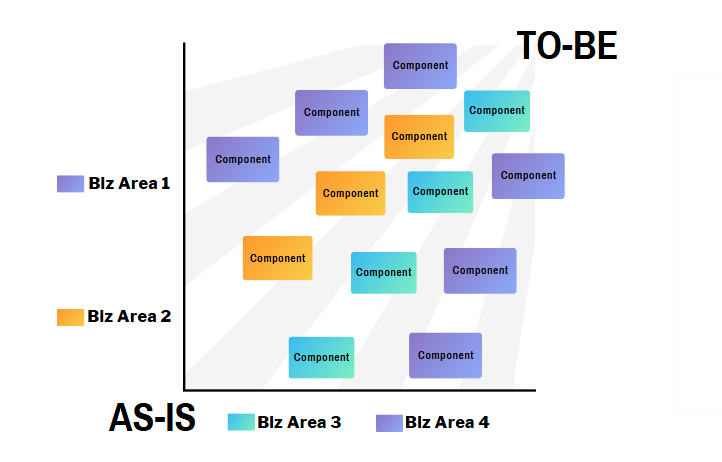
In the sunray diagram above, you notice the different business areas. Its unlikely that all of these business areas use the same business model. A portfolio manager would need to describes how their portfolio creates, delivers, and captures value through a coordinated set of multiple business models. The main purpose of these models is to explain how different businesses, units, or platforms collectively support corporate goals, share resources, and balance risk and return. This portfolio view shifts attention from the logic of a single business to the structure and management of an entire set of business models.
The first element of a portfolio-level business model is strategic intent. Strategic intent specifies why the organization operates multiple business models and what roles these models play in value creation and performance. Typical intents include diversification to spread risk and tap new markets, sensing to explore emerging opportunities and technologies, and complementing to create synergies between existing models. Large technology firms often use a sensing intent when they run experimental digital services alongside core products, while diversified industrial groups use a diversification intent to manage activities in distinct sectors.
The second element is the composition of the business model portfolio. Composition describes which business models are present, how they differ, and how they are grouped. Common patterns include portfolios that mix mature and experimental models, exploitative and exploratory models, or physical and digital models. Global corporations such as General Electric historically combined equipment sales models, long-term service contracts, and emerging digital service models in a single portfolio, which created both opportunities and tensions that later triggered restructuring.
The third element is inter-business-model complementarities and synergies. Complementarities describe how the presence of one business model increases the value or performance of another, for example through shared customers, shared data, or bundled offerings. Synergies arise when common platforms, brands, or capabilities support several models at the same time. Many platform companies use complementarities between advertising-based models, subscription models, and marketplace transaction models, where user data, brand trust, and technical infrastructure reinforce multiple revenue logics.
The fourth element is interdependencies and conflicts within the portfolio. Interdependencies capture technical, organizational, and market links that can either support or constrain the portfolio. Conflicts occur when models compete for the same resources, cannibalize each other’s revenues, or embody incompatible logics. Corporate splits, such as the separation of Hewlett Packard into HP Inc. and Hewlett Packard Enterprise, illustrate situations where rising intra-business-model complexity and weak complementarity led to a decision to reconfigure the portfolio architecture.
The fifth element is the governance and control structure for the portfolio. Governance defines who decides which business models to add, scale, change, or exit, and how those decisions connect to corporate strategy. Formal control frameworks describe multiple decision levels, including corporate strategy, business model portfolio, tactics, and operations. At the portfolio level, management sets targets for mix, balance, and synergy, monitors performance, and adjusts the configuration. Many firms use portfolio maps, matrices, and scoring systems to visualize and compare business models against strategic and financial criteria.
The sixth element is resource allocation and capability sharing across the portfolio. Resource allocation rules determine how capital, talent, data, and technology are distributed among business models. Capability sharing describes how distinctive competencies, such as analytics, platform engineering, or regulatory expertise, support multiple models. Digital enterprises frequently centralize platform development and data infrastructure as shared capabilities, while allowing front-end business models to vary in customer segment, value proposition, and revenue structure.
The seventh element is risk, return, and balance at portfolio level. Portfolio balance concepts adapt ideas from financial portfolio theory and innovation portfolio management to business models. A portfolio-level business model specifies how the mix of models manages uncertainty, stabilizes cash flows, and supports long-term growth. Leaders in new product development and project portfolio management articulate goals such as maximizing portfolio value, achieving a balanced mix of initiatives, and linking the portfolio to strategy; the same logic applies when the units of analysis are business models rather than projects.
The eighth element is dynamic management of portfolio evolution. Portfolio evolution describes how the set of business models changes over time as models are added, scaled, modified, combined, or retired. Analytical tools that track complementarity between models and complexity within models help corporate managers plan trajectory decisions, such as whether to consolidate overlapping models or to spin out new entities. Business model portfolios that support sustainability transitions or circular business models also rely on planned evolution, where new sustainable models gradually complement or replace legacy linear ones.
The ninth element is alignment with project and process portfolios. Alignment refers to the connection between the abstract business model portfolio and the concrete portfolio of projects and process changes that implement and support it. Project portfolio management approaches for Industry 4.0 and for business process improvement show how organizations select, prioritize, and sequence initiatives to operationalize new business models and capabilities. At portfolio level, the business model view guides which types of projects enter the pipeline and how they contribute to shared platforms and resources.
Well-known corporations illustrate these portfolio-level elements in practice. Alphabet coordinates a portfolio that includes advertising-based search, subscription-based cloud services, hardware, and experimental “Other Bets,” with strong complementarities in data, AI capabilities, and infrastructure. Amazon manages retail, marketplace, cloud computing, logistics, and subscription media models as a portfolio, using common capabilities in platforms, fulfillment, and customer data while balancing risk through diversification. These examples show how portfolio-level business models use strategic intent, composition, complementarities, governance, resource allocation, and evolution to shape value creation at corporate scale.
References:
- “The business model portfolio as a strategic tool for value creation and business performance” – Peter Westerveld, Erik Fielt, Kevin C. Desouza, Guy G. Gable
- “Bridging Strategic Planning and Business Model Management: A Formal Control Framework to Manage Business Model Portfolios and Dynamics” – Dietfried Globocnik, Rita Faullant, Zulaicha Parastuty
- “Strategically Managing the Business Model Portfolio Trajectory” – Yuliya Snihur, Llewellyn D. W. Thomas, Robert A. Burgelman
- “More can be better: operating multiple business models in a corporate portfolio” – Kirstin E. Bosbach, Anne-Sophie Brillinger, Björn Schäfer
- “Towards successful business model management with analytic network process-based feasibility evaluation and portfolio management” – Kwanyoung Im, Ki-Eun Nam, Hyunbo Cho
- “Corporate Sustainability Transformation: Exploring the Role of Knowledge Transfer in Business Model Portfolios” – Terje Berntsen
- “Open Innovation for Circular Business Models: Addressing the Right Challenge at the Right Time” – Daniel Wörner, Lukas Falcke, Manuel Ritter, Shaun West, Thomas Friedli
- “Corporate Strategy: Portfolio Models” – Eli Segev
- “Portfolio Management in New Product Development: Lessons from the Leaders-I” – Robert G. Cooper, Scott J. Edgett, Elko J. Kleinschmidt
- “Value-based process project portfolio management: integrated planning of BPM capability development and process improvement” – Marcus Lehnert, Alexander Linhart, Maximilian Röglinger
- “Business models, value capture, and the digital enterprise” – David J. Teece, Greg Linden