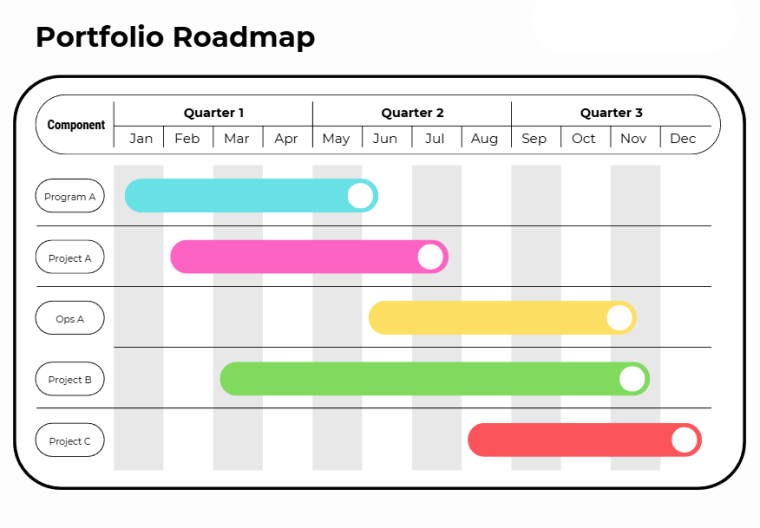
A portfolio roadmap provides a time-phased view of how the portfolio will be executed. PMI says: “The portfolio roadmap provides the high-level strategic direction and information in a chronological fashion for portfolio management execution and ensures that dependencies within the portfolio are established and evaluated.” The roadmap expresses the strategic direction already set in the portfolio vision, objectives, and strategic plan, then translates it into a sequenced view of work and dependencies.
Current research treats this roadmap as an integrating device for several kinds of analysis. Roadmapping work at the interface of innovation, enterprise architecture, and portfolio management describes the roadmap as the place where strategic objectives, architecture intents, and project-level decisions come together in a visual, temporal model. The roadmap connects long-term architecture or business model targets with near-term initiatives, experiments, and capability builds, and it exposes gaps, overlaps, and timing conflicts that are not visible when projects are viewed in isolation.
I have classically taught the tools of roadmapping as PIC: Prioritization Analysis, Interdependency Analysis, and Cost-Benefit Analysis.
Interdependency analysis per PMI is performed to look at your portfolio in relation to other portfolios and/or to the portfolio environment. Recent portfolio research calls for explicit modeling of different relationship types, such as resource sharing, knowledge transfer, outcome coupling, and technological complementarity, and distinguishes these from negative interactions like mutual exclusivity or risk contagion. Review work proposes a refined terminology that separates interdependencies, interactions, and synergies and encourages organizations to treat these as first-class design parameters when shaping portfolios. Quantitative models increasingly use network representations, Bayesian networks, and compatibility matrices to estimate cascading effects, combined value, and failure propagation across portfolios, rather than assuming independent projects.
Cost–benefit analysis in contemporary portfolio work appears as one dimension among several, rather than the single decision lens. Multi-criteria methods integrate economic measures with sustainability metrics, risk exposure, stakeholder value, and capability impacts. Approaches such as fuzzy quality function deployment combined with data envelopment analysis, robust portfolio modeling with interval cost data, or system-dynamics-based value–risk simulations illustrate this shift. These methods treat costs and benefits as uncertain, scenario-dependent quantities and support the generation of alternative portfolio configurations and roadmaps, with explicit trade-offs between financial returns, non-financial value, and risk.
When it comes to prioritization analysis, again PMI recommends looking at your portfolio in relation to other portfolios. They write that “the portfolio manager should compare strategic objectives, prioritize objectives, and perform strategic assessment against current enterprise portfolios.”
PMI’s wording is muddy, but what it describes lines up with how research treats two distinct but linked levels of objectives:
- Organizational (enterprise) strategic objectives
Portfolio management literature is clear that portfolios exist to realize enterprise strategy. Strategic alignment is consistently defined as the match between portfolio content and the organization’s strategy, not a separate “portfolio-only” strategy. Organizational strategy provides the primary objectives and priorities, and portfolio management translates these into investment choices and sequencing of initiatives. - Portfolio‑level strategic objectives derived from the organizational strategy
Studies also show that effective portfolio work introduces an intermediate “portfolio strategy” layer. This layer refines broad corporate goals into portfolio‑specific objectives and design targets (for example, desired mix of innovation types, risk levels, time horizons, or technology platforms) and then uses these derived objectives as explicit criteria for selection, prioritization, and roadmapping. Portfolio evaluation models, multi‑criteria prioritization systems, and agile portfolio techniques all operationalize this by starting from organizational strategy and then expressing it as portfolio‑level criteria and themes that guide decisions.
When PMI says the portfolio manager should “compare strategic objectives, prioritize objectives, and perform strategic assessment against current enterprise portfolios,” the intent aligns with this two-level view. The comparison and prioritization activity primarily concerns organizational strategic objectives, but the assessment step happens at the portfolio layer and across portfolios. The portfolio manager works with enterprise‑level strategy, translates it into portfolio‑level objectives, and then assesses and adjusts one or more portfolios against those objectives, including cross‑portfolio trade‑offs and synergies.
Enterprise-wide interdependency and prioritization analysis is becoming more prominent, especially in IT and architecture-driven contexts. Modern application and technology portfolio management frameworks rely on unified taxonomies and automated relationship mapping to expose dependencies across application, information, and technology portfolios. Research on connected portfolios advocates cross-portfolio dependency mapping as a foundation for integrated governance and strategic planning. This work aligns with the practice view that portfolio decisions should consider interactions not only within a single portfolio but also across related portfolios, such as applications, data, technology, and change initiatives, and that roadmaps should reflect these cross-portfolio relationships through shared milestones, synchronized transitions, and joint risk treatments.
These days, prioritization analysis has moved from one-shot ranking toward iterative portfolio decision analysis that supports scenario-based roadmapping. Methods such as PROMETHEE, multi-choice goal programming, real options portfolio optimization, and extended robust portfolio modeling generate candidate portfolios and roadmaps under different budget, dependency, and value assumptions. Work on comprehensive decision-support systems emphasizes “double prioritization”: one pass for strategic fit and value, another for executability under resource and capability constraints. These systems take a list of project and program candidates, apply structured preference models, and then feed selected subsets into roadmap development, where timing, sequencing, and interdependencies are examined again.
Roadmapping occupies a central position in this enterprise-wide view. Studies linking enterprise architecture and project portfolio management describe roadmapping as the technique that brings strategic goals, architectural constraints, and portfolio planning together. The roadmap contains dependency analyses for resources, finance, and quality across initiatives, along with cost–benefit and prioritization information that has been shaped by earlier portfolio analysis. In these accounts, the roadmap does not simply visualize a pre-decided portfolio; it supports iterative refinement by highlighting cross-portfolio impacts, surfacing bottlenecks created by shared platforms or capabilities, and allowing decision-makers to explore alternative sequences and groupings of work.
Risk-focused research reinforces the importance of integrating interdependency, cost–benefit, and prioritization analysis when building and maintaining the roadmap. Portfolio risk models that incorporate project interdependencies show how coupled schedules, shared resources, and market interactions can generate portfolio-level risks such as liquidity strain, resource contention, and demand–supply mismatches. Value-oriented portfolio risk management frameworks simulate how different risk mitigation strategies and sequencing choices affect multi-dimensional portfolio value over time. These approaches feed back into roadmap design by indicating where to place buffers, which interdependent projects to decouple or cluster, and how to time initiatives to balance value creation with risk exposure.
Current work on portfolio decision-making under uncertainty also reflects a trend toward more interactive, exploratory use of analysis results in roadmap conversations. Methods that generate a set of robust or efficient portfolios, rather than a single optimal solution, support workshops where stakeholders compare alternative roadmaps and examine how interdependencies and cost–benefit profiles change under different budget levels or strategic emphases. This style of decision-making treats interdependency analysis, cost–benefit analysis, and prioritization as linked activities that inform an evolving roadmap, rather than as linear steps that end once a preferred portfolio is selected.
References:
- PMI’s Standard for Portfolio Management, v3
- “Project Portfolio Selection considering interdependencies: A review of terminology and approaches” – Gustavo B. Vieira et al.
- “Managing project interdependencies in IT/IS project portfolios: a review of managerial issues” – Sameer Bathallath et al.
- “Robust portfolio modeling with incomplete cost information and project interdependencies” – Juuso Liesiö et al.
- “A methodology for project portfolio selection under criteria prioritisation, uncertainty and projects interdependency – combination of fuzzy QFD and DEA” – Hamed Jafarzadeh et al.
- “A collective efficacy-based approach for bi-objective sustainable project portfolio selection using interdependency network model between projects” – Mohadeseh Ebnerasoul et al.
- “Project portfolio risk analysis with the consideration of project interdependencies” – L. Bai et al.
- “Portfolio Scenarios for Interrelated Projects” – V. Agrawal et al.
- “Application of Interaction Effect Multichoice Goal Programming in Project Portfolio Analysis” – Su-Lan Zhai et al.
- “A Comprehensive System to Support Decision Making in Highly Complex Project Portfolio Situations” – Efraín Solares et al.
- “Connecting Enterprise Architecture and Project Portfolio Management: A Review and a Model for IT Project Alignment” – Christof Gellweiler
- “Reclaiming Control: Enterprise Architects on Winning with APM (Application Portfolio Management)” – Kiran Kumar Chitrada
- “Building Connected Portfolios: A Framework for Aligning Enterprise Application, Information, and Technology Assets” – Kiran Kumar Chitrada
- “Managing innovation portfolios: From project selection to portfolio design” – Haijian Si, Stylianos Kavadias, Christoph Loch
- “Practices of strategic alignment in and between innovation project portfolios” – M. Martinsuo, Roosa Anttila
- “Portfolio Management: A New Direction in Public Sector Strategic Management Research and Practice” – [Author not listed in excerpt]
- “Analysis and Design of a Project Portfolio Management System” – Driss El Hannach, R. Marghoubi, Z. E. Akkaoui, Mohamed Dahchour
- “Strategic Alignment and Value Optimization: Unveiling the Critical Role of Project Portfolio Management for a Flexible Environment” – Francisco I. Rodrigues Coelho et al.
- “Designing a hybrid system dynamic model for analyzing the impact of strategic alignment on project portfolio selection” – F. H. Rad, Seyed Mojtaba Rowzan
- “The Impact of Project Portfolio Management on Enterprise Strategic Objectives” – Qiting Song