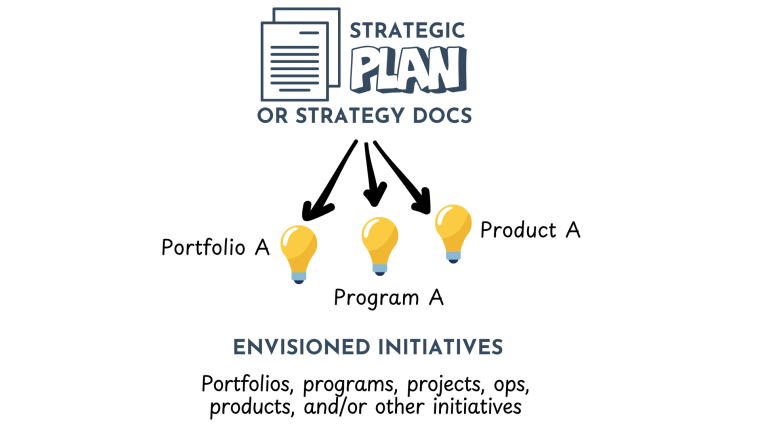
Portfolio and program managers often start from an ambiguous translation of strategy into work. Research on project portfolio management shows that many organizations treat strategy as a set of broad themes or high-level initiatives, without providing the structured objectives and measures needed for systematic execution. Strategy documents commonly describe priorities in qualitative terms, while the rigor appears later in budgeting, compliance, or performance reporting, rather than at the moment initiatives are defined and authorized. This gap shapes how portfolios are constructed and how programs are set up for success or underperformance.
Strategy-to-portfolio translation typically follows a cascade from strategic intent to strategic objectives, then to portfolios, programs, and projects. In many organizations this sequence assumes a “pre-prepared” strategic plan that is handed to portfolio and program managers as a given, with limited involvement in setting the original objectives. Studies highlight that project and program managers are often excluded from the early phase where strategic objectives are framed and quantified, even though their participation would improve the feasibility and clarity of the resulting portfolios. The starting point for them is frequently a list of initiatives aligned to broad goals, rather than a precise, testable objective hierarchy.
Portfolio management literature identifies alignment with strategy as a central function, but it also notes that alignment is often treated as a selection criterion applied to existing ideas, rather than as a design activity that shapes which initiatives should exist in the first place. In practice, this means portfolio managers receive a pool of proposals that only loosely link to strategic intentions. Analyses of innovation and strategic initiative portfolios show that a large share of ideas originates from middle managers and staff, and that these ideas often lack explicit connection to specific strategic targets if guidance is vague. Without a clearly articulated set of desired outcomes, portfolio processes become exercises in ranking what is already on the table, not in constructing a coherent set of initiatives that collectively cover strategic goals.
Evidence from case studies indicates that organizations with mature portfolio management treat the portfolio as the operational representation of strategy. In these contexts, strategic objectives are decomposed into explicit targets, and portfolio managers participate in framing what success looks like at the portfolio level. Strategic control mechanisms at the portfolio level support both deliberate strategy implementation and recognition of emergent opportunities. This dual role requires a starting point that includes not only themes and priorities but also the explicit links between those priorities, the portfolio composition, and measurable outcomes across time.
The clarity of the starting brief varies significantly with governance structures. Where portfolio management is integrated into broader strategic management, strategic planning and portfolio design are linked so that public value or business value is explicitly traded against risk, resource limits, and timing. Where this integration is weak, portfolio managers receive strategic plans that describe ambitions but omit the decision logic for trade-offs. Research in project governance stresses the importance of governance elements such as portfolio boards, sponsorship, and project management offices that translate strategy into consistent decision criteria, escalation paths, and performance expectations. These structures influence whether portfolio and program managers work from a coherent decision framework or from a patchwork of local interpretations.
Empirical and conceptual work on strategic alignment shows that alignment is not a one-off handover but a continuous activity. Managers use social, mechanistic, and structural practices to keep portfolios in step with evolving strategy. Social practices include dialogue, negotiation, and boundary-spanning roles that interpret strategy for different portfolios. Mechanistic practices involve formal processes, scorecards, and periodic reviews that compare portfolios against strategic objectives. Structural practices concern how responsibilities, forums, and reporting lines are arranged so that information moves between strategy-makers and portfolio managers. Where these practices are robust, portfolio managers are more likely to receive and maintain a clear line of sight from initiatives to strategy, with explicit objectives, indicators, and target values that can be adjusted as contexts change.
Studies that examine the content of portfolio decision-making find that many organizations rely heavily on financial or qualitative scoring methods and treat performance measures primarily as ex-post evaluation tools. Constructivist performance frameworks and program-oriented approaches, however, demonstrate that portfolios can be built around explicit objectives-results structures from the outset. These structures use matrices that connect strategic objectives, expected results, indicators, and management actions across multiple levels. They provide portfolio and program managers with a starting point that defines purpose, desired effects, and how those effects will be observed and interpreted. In such systems, indicators are not added later but are part of the design of initiatives and the architecture of the portfolio.
Research on conservation and public-sector programs illustrates how shared indicators across a portfolio enable aggregation of results and adaptive management. When projects and programs use common indicators tied to higher-level goals, data from individual efforts can be combined to assess portfolio-level impact. This approach requires that when strategy is subdivided into initiatives, each initiative receives objectives, indicators, and monitoring protocols that align upward. Program managers in these environments begin with clear expectations about what they are contributing to and how that contribution will be measured at multiple levels.
Agile and flexible portfolio management approaches in government and private organizations show another pattern in the quality of the starting point. Agile portfolio management emphasizes value-centric decision-making, iterative planning, and outcome-based metrics. In these approaches, portfolio managers and program leaders work from guardrails rather than fixed long-range plans. Guardrails define strategic intents, value hypotheses, and constraints, often accompanied by explicit metrics for flow, value delivery, and risk. The starting point for them includes a structured but adaptive articulation of purpose and expected outcomes, with room to adjust indicators as learning occurs. This differs from a purely qualitative briefing and supports predictive, adaptive, and hybrid management modes.
Across studies, a consistent observation emerges: successful portfolios depend on structural alignment between strategy, decision criteria, organizational design, and information flows. Structural alignment means that the criteria used to choose and evaluate projects are connected to strategy and that the organization is configured to process the information required by those criteria. When this alignment is present, portfolio managers receive strategy in a form that can be operationalized: clear objectives, agreed measures, and resourcing and governance structures that support them. When alignment is absent, they receive high-level narratives and must improvise local criteria, leading to inconsistency and a heavier reliance on intuition, politics, and ad hoc reasoning during selection and reprioritization.
Research on middle managers in program and portfolio management highlights their role as translators of strategy. High-performing organizations give these managers defined responsibilities and tools to interpret strategic intent, negotiate scope, and shape initiative design. In such settings, the starting point is not a static document but a negotiated understanding of priorities that is periodically revisited through portfolio reviews, strategic dialogues, and feedback from execution. Middle managers help to refine objectives, propose or reshape initiatives, and influence the selection of indicators that matter both to executives and to delivery teams.
Strategic initiative portfolio studies suggest that many organizations have too many disconnected initiatives that dilute focus. These studies advocate managing initiatives as an integrated portfolio, with explicit practices for limiting the number of initiatives, sequencing them, and aligning them to strategic challenges. For portfolio and program managers, this translates into a starting point that includes a defined scope of strategic challenges, a rationale for which initiatives address which challenge, and a time-phased view of when outcomes should be realized. Without such structure, initiative proliferation leads to overloaded portfolios and ambiguous accountability for results.
Recent conceptual and empirical work positions organizational strategy as a mediating mechanism that connects flexible portfolio management practices to value creation. This work identifies levels of portfolio selection criteria, portfolio management sophistication, and strategic clarity that are necessary to realize portfolio value. It emphasizes that risk and change management must be embedded alongside portfolio selection and management, so that portfolios can adapt while still tracking toward defined value outcomes. For portfolio and program managers, this blend of flexibility and clarity means starting from objectives that are explicit but revisable, with indicators that support early detection of value erosion and opportunities for adjustment.
Under mid-range planning horizons, especially in small and medium-sized enterprises, portfolio management concepts support strategic innovation and foresight. Organizations in these contexts use portfolio models to balance exploitation and exploration, manage limited resources, and absorb innovation into operations. The starting point for program and portfolio managers here includes mid-term strategic intents, capability development goals, and a set of candidate initiatives shaped by both top-down intent and bottom-up opportunity sensing. The clarity of objectives and metrics varies, but research argues that more formal adoption of portfolio models improves foresight, decision-making, and the capacity to integrate innovations.
Theories that connect project portfolios with their broader context argue for a wider definition of portfolio success and for the inclusion of external stakeholder expectations, institutional pressures, and resource dependencies. This perspective implies that portfolio and program managers benefit from starting conditions that articulate not only internal strategic goals but also contextual constraints and stakeholder value propositions. A starting point that combines internal objectives with external expectations supports more robust portfolio design and more defensible trade-offs when conflicts arise.
Taken together, contemporary research suggests that best practice in program and portfolio management begins with a structured articulation of strategy that can be decomposed into objectives, indicators, and decision criteria at portfolio and program levels. The quality of the starting point varies widely across organizations, but those that integrate portfolio management into strategic management, involve managers from multiple levels in strategy formation, and use explicit objective-indicator-result matrices provide their portfolio and program managers with clearer, more actionable direction. This structured starting point, combined with adaptive governance and continuous strategic control, supports predictive planning where possible, adaptive adjustments where necessary, and hybrid approaches that blend foresight with iteration.
References
Portfolio Management: A New Direction in Public Sector Strategic Management Research and Practice – [Author not listed]
Investigating Agile Portfolio Management Techniques for Prioritizing Strategic Initiatives in Large-Scale Government IT Projects – Martina Ononiwu, Tony Isioma Azonuche, Joy Onma Enyejo
Creating competitive advantage from strategy through execution: leading modern approaches in project portfolio management – Joseph G. Mews
Strategic Innovation, Foresight and the Deployment of Project Portfolio Management under Mid-Range Planning Conditions in Medium-Sized Firms – Nick Hadjinicolaou, M. Kader, Ibrahim Abdallah
Involving program/project managers in organizational strategic planning? – A. Stretton
The influence of business strategy on project portfolio management and its success — A conceptual framework – Sascha Meskendahl
Successful project portfolio management beyond project selection techniques: Understanding the role of structural alignment – M. Kaiser, F. E. Arbi, F. Ahlemann
The role of project portfolio management in fostering both deliberate and emergent strategy – J. Kopmann, Alexander Kock, C. Killen, H. Gemünden
The management of project management: a conceptual framework for project governance – Eric G. Too, P. Weaver
Project, program and portfolio management as modes of organizing: Theorising at the intersection between mergers and acquisitions and project studies – J. Geraldi, S. Teerikangas, Gustavo Birollo
Portfolio Management: A Strategic Approach – Kenneth H. Rose
Management of project portfolios: Relationships of project portfolios with their contexts – M. Martinsuo, J. Geraldi
Practices of strategic alignment in and between innovation project portfolios – M. Martinsuo, Roosa Anttila
Strategic Alignment and Value Optimization: Unveiling the Critical Role of Project Portfolio Management for a Flexible Environment – Francisco I. Rodrigues Coelho, F. Bizarrias, R. Rabechini, C. D. P. Martens, M. Martens
A performance measurement framework in portfolio management: A constructivist case – Rogério T. O. Lacerda, L. Ensslin, S. Ensslin
Managing innovation portfolios: From project selection to portfolio design – Haijian Si, Stylianos Kavadias, C. Loch
ANALYSIS OF THE FRAMEWORK MONITORING SYSTEM BASED ON OBJECTIVES-RESULTS REGARDING THE DEVELOPMENT OF SETTLEMENTS – Maksym Filiak, Yuliia Zavadovska
Practices, Roles, and Responsibilities of Middle Managers in Program and Portfolio Management – Tomas Blomquist, R. Müller
Strategic initiative portfolios: How to manage strategic challenges better than one at a time – Sven Kunisch, T. Keil, Michael Boppel, Christoph Lechner
The Holy Grail of biodiversity conservation management: Monitoring impact in projects and project portfolios – P. Stephenson