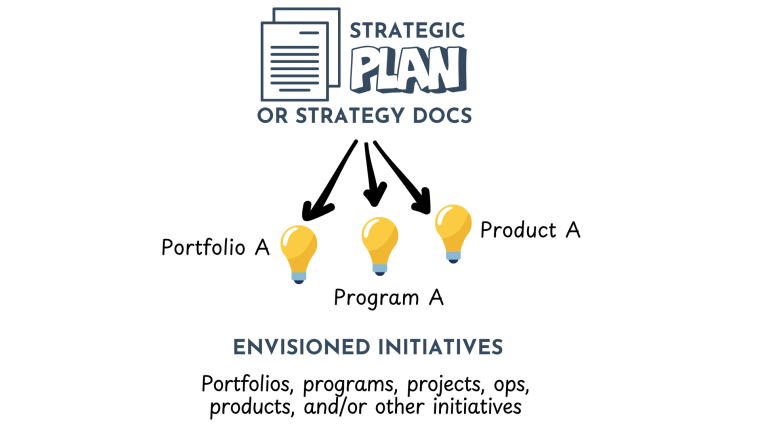
Portfolio and program managers frequently receive a partial view of strategic purpose. The organization may have a mission, a set of strategic themes, and a slide deck that describes ambitions, yet the translation into concrete portfolio-level objectives and constraints remains incomplete. The result is a starting point where managers recognize the broad direction but lack the precision needed to guide selection, sequencing, and adaptation of initiatives in a consistent way across the portfolio.
The same pattern appears for vision. Executives often define a future state in broad qualitative terms, while portfolio and program managers need an operational vision that specifies which capabilities must be built, which markets or services will change, and over what time horizon. Strategic portfolio management work shows that many executives cannot clearly describe how each major program or project supports strategic objectives, which indicates that the vision has not been decomposed down to portfolio and program layers. Managers at these layers then infer the vision from scattered messages, rather than working from a clearly articulated, testable view of the future.
Research on portfolio management highlights that a well-articulated mission, vision, goals, strategy, and targets is a prerequisite for robust portfolio definition. In many organizations, this articulation stops at the corporate level and does not propagate as a structured purpose-object-indicator-metrics chain. Portfolios and programs are expected to “align with strategy,” but they are handed only thematic guidance and funding envelopes. Where this happens, purpose is known in narrative form, while the operational definition of success, acceptable risk, and required value is left open to interpretation.
The gap between strategic intent and actionable purpose at portfolio and program levels rests on how strategy and portfolio management interact. Strategy work often occurs in executive and corporate planning forums, while portfolio processes run in parallel with their own cadences, criteria, and data. Studies of effective portfolio management emphasize a high degree of interaction with strategic management and a consulting role for the project management office. In such environments, purpose and vision are jointly elaborated, and portfolio managers participate in refining strategic drivers and outcome definitions before initiatives are locked in.
Structural alignment plays a major role in whether portfolio and program managers receive a clear or ambiguous brief. Structural alignment means that decision criteria, governance bodies, reporting systems, and organizational roles are designed to support portfolio-level strategy execution. When criteria for selection and evaluation are derived from explicit strategic objectives and are supported by information systems, portfolio managers work from a stable purpose framework. When structures and information flows do not follow from strategic criteria, managers operate within silos and rely on local interpretations of purpose and vision, which vary across business units and programs.
The starting state also reflects how organizations understand portfolio management as a discipline. Some organizations treat portfolio management mainly as a capacity and cost optimization function, focusing on resource utilization and short-term value metrics. In those contexts, purpose is narrowed to financial or efficiency outcomes, and broader strategic aspirations, such as capability building, innovation, or societal value, remain abstract. Other organizations adopt a broader view of value management in portfolios, which includes strategic, non-commercial, ecological, societal, and learning dimensions. In these cases, portfolio-level purpose is explicitly multidimensional, and program managers receive guidance on which value dimensions matter and how they will be assessed.
The relationship between portfolio and program management also shapes clarity. Portfolios ideally represent the organization’s intent, direction, and priorities, while programs focus on coordinating related projects to deliver specific change outcomes. When program managers act as “mini portfolio managers,” they need a line of sight from corporate purpose to program purpose to project deliverables. Research on the portfolio–program relationship describes how portfolios define governance frameworks, performance expectations, and value measures that programs should adopt. Where these connections are clear, programs inherit a well-specified purpose and contribution statement. Where they are weak, programs construct their own purpose statements that may only loosely correspond to portfolio aims.
Decision-making studies in portfolios show that an effective process requires a “portfolio mindset” that keeps the entire portfolio and the long-term strategy in view. Many organizations maintain a strong focus on short-term performance and lack mechanisms that protect long-term strategic options. Portfolio managers in such environments understand the immediate performance purpose but lack clarity about how their decisions should balance current results with future positioning. They know the stated vision but cannot translate it into portfolio-level trade-off rules between exploitative and exploratory investments.
Best practice for contemporary portfolio and program management requires purpose to be defined at multiple levels and in multiple time horizons. At the corporate level, purpose describes why the organization exists and what value it seeks to create. At the strategic level, purpose is expressed as outcome-oriented objectives and target states. At the portfolio level, purpose becomes a design statement: which combination of initiatives will realize those objectives under given resource, risk, and timing constraints. At the program level, purpose specifies the concrete capabilities, products, services, or policy changes that will contribute to portfolio outcomes. Without this tiered decomposition, the understanding of purpose becomes weaker with each organizational layer.
Predictive, adaptive, and hybrid management contexts place different demands on how purpose and vision are expressed to portfolios and programs. Predictive contexts rely on stable strategic assumptions and long planning horizons, so portfolio managers need clear, quantified objectives, fixed decision criteria, and detailed milestone structures. Adaptive contexts operate with frequent change in environment and strategy, so portfolio purpose must be expressed as guiding principles, value hypotheses, and boundaries, along with mechanisms for continual reprioritization and learning. Hybrid contexts combine long-term directional purpose with shorter, adaptive cycles; here, managers need both a durable vision and explicit signals for when to pivot or reframe elements of the portfolio.
Agile and lean portfolio management approaches in both private and public sectors provide useful patterns. These approaches define portfolio-level guardrails that express strategic themes, investment horizons, and outcome metrics, while granting programs and teams autonomy to adapt scope and solutions. Portfolio and program managers in these settings receive purpose and vision as a structured but revisable contract: clear constraints on value, risk, and capacity, plus defined metrics such as customer value, time to impact, and flow efficiency. The initial state here combines directional clarity with operational flexibility, which supports both predictive planning for stable components and adaptive management for uncertain ones.
Governance arrangements strongly influence whether purpose and vision are shared in a consistent way. Effective project governance frameworks describe four interacting elements: portfolio management, sponsorship, project management offices, and project and program support. Portfolio management selects and maintains the right mix of initiatives; sponsors provide a direct link between executives and delivery; PMOs give oversight and strategic reporting; and support functions help programs translate objectives into plans. When these elements operate cohesively, portfolio and program managers receive a coherent purpose narrative, sustained through governance forums, performance reviews, and decision cycles.
Organizational culture and middle management practices affect how incomplete strategic messages are interpreted. Research on middle managers in program and portfolio management shows that they play a translation role between strategic intent and operational realities. When culture fosters involvement, consistency, and a shared sense of mission, middle managers collaborate to refine purpose statements, challenge ambiguous directives, and seek alignment across programs. When culture tolerates competing narratives and isolated decision-making, each portfolio or program may build its own version of purpose and vision, leading to misaligned investments and duplicated or conflicting initiatives.
The starting state for portfolio and program managers can be described as a variable combination of formal and informal purpose signals. Formal signals include strategy documents, portfolio charters, governance mandates, and performance frameworks. Informal signals include executive behavior, funding decisions, and organizational stories about “what really matters.” Best practice suggests that formal signals should codify the organization’s intent with sufficient precision to guide choices under uncertainty, while informal signals should reinforce, not contradict, those codified priorities. Where formal and informal signals diverge, managers experience uncertainty about the true purpose and vision, even if official documents seem clear.
Contemporary research on flexible portfolio management emphasizes that organizational strategy acts as a mediating mechanism between portfolio practices and realized value. Flexible portfolio management relies on adaptive risk and change management, but it still depends on a stable core of strategic purpose that defines value. The starting point for portfolio and program managers in such organizations includes explicit selection criteria tied to strategy, agreed thresholds for acceptable risk, and processes for revisiting objectives when assumptions no longer hold. Purpose and vision here are known as working hypotheses that guide action and are periodically recalibrated through structured learning.
A more advanced view of value in portfolios expands purpose beyond financial outcomes to include public value, ecological impact, social outcomes, and organizational learning. In public sector and mission-driven contexts, portfolio management trades off risk against public value or mission outcomes rather than profit alone. Portfolio and program managers in these settings need a starting point that articulates which value dimensions have priority, how trade-offs among them will occur, and which indicators will represent progress. Without such clarity, decisions revert to narrow or familiar metrics, and broader mission or sustainability purposes remain aspirational.
Visual representations, data, and analytics can support a stronger connection between purpose, vision, and portfolio structure. Studies show that graphical network displays of projects and interdependencies help decision-makers understand how initiatives combine to support strategic objectives. These tools give portfolio and program managers an explicit map of how their components contribute to higher-level outcomes and where dependencies require coordinated action. Predictive analytics, including scenario modeling and AI-driven prioritization, can further help refine which initiatives best match strategic intent under different futures, but these tools only add value when the underlying purpose and vision are expressed clearly enough to translate into model parameters.
Best practice for future-ready portfolio and program management brings these insights together into a more deliberate starting state. Purpose is defined as a multi-level, multi-dimensional construct that links mission to measurable outcomes. Vision is translated into portfolio and program design principles, investment horizons, and capability roadmaps. Governance, culture, and structural alignment support this translation and keep it current across predictive, adaptive, and hybrid contexts. Portfolio and program managers in such environments do not need to reconstruct purpose and vision from fragments; they receive them as structured, shared, and revisable guides for consistent decision-making and learning.
References
Strategic Alignment and Value Optimization: Unveiling the Critical Role of Project Portfolio Management for a Flexible Environment – Francisco I. Rodrigues Coelho, F. Bizarrias, R. Rabechini, C. D. P. Martens, M. Martens
Program and Portfolio Management Relationship and Support – Ginger Levin, Nicole Pitotti
The management of project management: a conceptual framework for project governance – Eric G. Too, P. Weaver
Successful project portfolio management beyond project selection techniques: Understanding the role of structural alignment – M. Kaiser, F. E. Arbi, F. Ahlemann
Alignment with organizational structures, management systems and processes – Elvira Molitor
The relevance of portfolios and portfolio management in today’s organizations – Thomas Walenta
Portfolio Management: A New Direction in Public Sector Strategic Management Research and Practice – [Author not listed]
Value Management in Project Portfolios: Identifying and Assessing Strategic Value – M. Martinsuo, C. Killen
Investigating Agile Portfolio Management Techniques for Prioritizing Strategic Initiatives in Large-Scale Government IT Projects – Martina Ononiwu, Tony Isioma Azonuche, Joy Onma Enyejo
Creating competitive advantage from strategy through execution: leading modern approaches in project portfolio management – Joseph G. Mews
Exploring Portfolio Decision-Making Processes – L. Kester, A. Griffin, E. Hultink, K. Lauche
Principles in Project Portfolio Management: Building Upon What We Know to Prepare for the Future – L. Hansen, Per Svejvig
How to Convert Strategy and Innovative Demand into Actionable Plans – Shan Rajegopal
How to Achieve Effectiveness in Project Portfolio Management – P. Patanakul
Delivering organizational strategy with portfolio management – Martin R. Sedlmayer
Strategic portfolio management – David Williams, T. Parr
Project Portfolio Management: Leading the Corporate Vision – Shan Rajegopal, Philip McGuin, James Waller
Reconciling alignment, efficiency, and agility in IT project portfolio management: Recommendations based on a revelatory case study – D. Hoffmann, F. Ahlemann, Stefan Reining
Understanding project interdependencies: The role of visual representation, culture and process – C. Killen, Cai Kjaer
Portfolios, programs, and projects in strategic marine-fisheries sustainability and blue growth: a case study in Indonesia – W. S. Ciptono, Suadi, S. A. Cahyacipta, Bagaskara