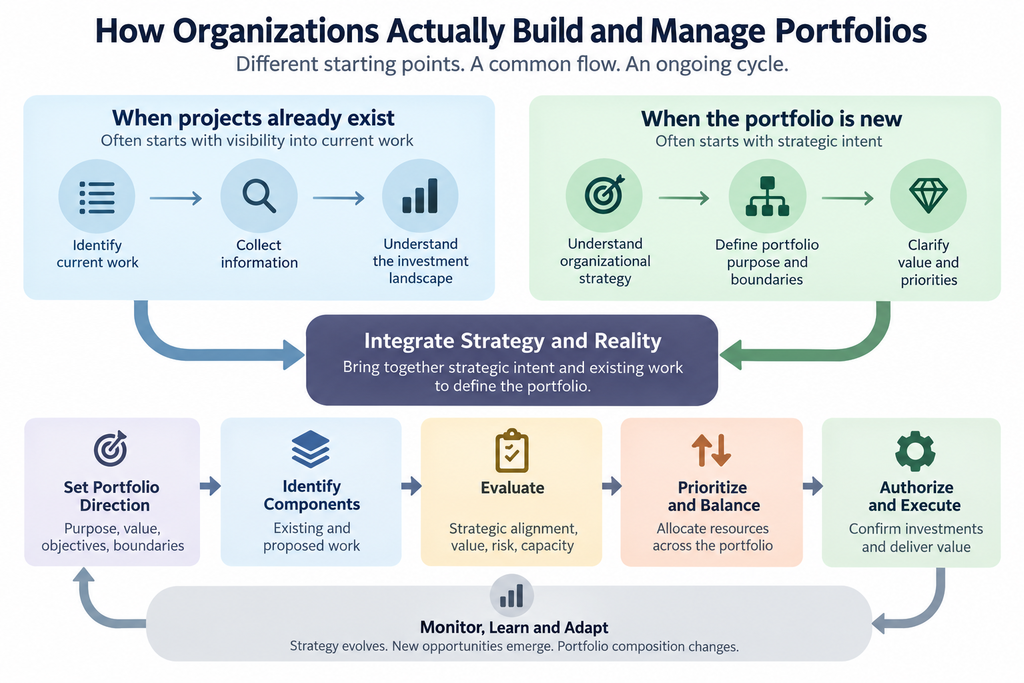
Portfolio management is often described as though organizations follow a clean sequence: identify strategy, assemble a list of components, evaluate them, prioritize them, authorize the portfolio, and then monitor performance. Actual practice is messier. Organizations enter portfolio management from different starting conditions, and the sequence depends heavily on whether they already have substantial work underway, whether the portfolio itself is new, and how mature the organization is at translating strategy into investment decisions.
The available empirical literature does not provide a clean statistic showing what percentage of organizations begin with a component inventory versus beginning with strategic planning. Studies generally examine established portfolios, portfolio decision processes, innovation portfolios, or portfolio performance rather than asking organizations which activity came first. What the evidence does show is that organizations commonly use several different entry patterns.
When Organizations Already Have Projects, They Usually Start by Figuring Out What They Have
Many organizations introduce formal portfolio management after projects and programs already exist. Departments have initiatives underway. Sponsors have obtained funding. Resources are already committed. Some projects may have been approved through different governance structures, and some may have weak or outdated connections to strategy.
In this environment, portfolio management frequently begins with visibility.
Organizations identify the projects, programs, initiatives, products, or other investments already consuming resources. They collect comparable information about them. They determine what each initiative costs, what resources it uses, what outcomes it is expected to produce, what dependencies exist, and how strongly each initiative supports current organizational priorities.
This is effectively an inventory process, whether the organization formally calls it a component inventory or simply creates a master project list, investment register, pipeline, portfolio database, or enterprise roadmap.
Several empirical studies of portfolio management effectively begin from this reality. Filippov and Mooi studied experienced portfolio managers working in organizations with established portfolio mechanisms and examined the alignment of ongoing projects with business strategy. Cooper, Edgett, and Kleinschmidt’s large portfolio studies likewise looked at organizations managing existing pipelines of development projects and making decisions about which projects to continue, fund, accelerate, delay, or terminate.
So inventory-first behavior is common when portfolio management is being imposed on an already active project environment.
The organization is solving a very practical problem: “What are we currently spending money and capacity on?”
When the Portfolio Is New, Organizations Are More Likely to Start With Strategic Intent
A different pattern appears when an organization deliberately creates a new portfolio to address a strategic area.
Examples could include creating a digital transformation portfolio, an employee experience portfolio, a sustainability portfolio, a product innovation portfolio, or a modernization portfolio.
Here, organizations often begin by defining what the portfolio is supposed to accomplish.
The work typically involves interpreting organizational strategy, identifying the strategic objectives that fall within the portfolio’s domain, clarifying the portfolio’s intended contribution, establishing boundaries, and determining what forms of value matter.
Only after that strategic framing becomes reasonably clear does it make sense to ask what initiatives belong inside the portfolio.
This does not mean an organization waits until every strategic question has been settled before looking at existing work. Strategy work and discovery often happen concurrently. Leaders may examine current initiatives while defining the portfolio because those initiatives reveal existing capabilities, obligations, gaps, and opportunities.
The distinction is that the existing project list does not necessarily define the portfolio.
The portfolio’s purpose defines what the project list should eventually contain.
Organizations Often Define Strategic Areas Before They Define Individual Investments
One recurring practice in the portfolio literature is the use of strategic arenas, categories, themes, investment areas, or strategic buckets.
Instead of beginning with hundreds of proposed projects and asking which projects score highest, organizations first decide where they want resources to go.
A business might decide that its innovation investment should be concentrated across three strategic areas. A technology portfolio might distinguish cybersecurity, infrastructure modernization, customer platforms, and data capabilities. A public-sector portfolio might allocate attention across regulatory requirements, service delivery, modernization, and resilience.
This is important because prioritization does not happen in a vacuum. Organizations frequently make higher-level allocation decisions before comparing individual initiatives.
A major benchmarking study by Cooper, Edgett, and Kleinschmidt examined 105 U.S. businesses. About 64.8% clearly identified strategic arenas in which they wanted to focus their new-product development efforts. Among the best-performing organizations, 69.0% did so, compared with 53.8% of the lowest-performing organizations.
That suggests that a substantial number of organizations begin portfolio thinking at a level above individual components.
They first ask where they want to compete, invest, grow, improve, or build capability.
Then they decide which initiatives deserve resources within those areas.
Many Organizations Still Have Weak Strategy-to-Portfolio Translation
One of the more revealing findings in the empirical literature is that organizations frequently have projects and portfolio processes before they have clearly defined how those investments contribute to strategy.
In the same benchmarking study, only 46.3% of businesses clearly defined the role that new-product development was expected to play in achieving overall business goals. Among the best-performing organizations, 58.6% had defined that relationship, compared with 30.8% of the lowest-performing organizations.
Only 38.1% of organizations had clearly defined longer-term new-product goals. Among the best performers, the percentage was 51.7%.
This helps explain why real portfolio management often begins with some combination of project inventory and strategic clarification.
Organizations frequently inherit portfolios that have already evolved through years of budget cycles, executive sponsorship, operational needs, regulatory requirements, acquisitions, technology decisions, and local departmental priorities.
The portfolio manager may therefore need to work in both directions at once.
One direction asks, “What should this portfolio accomplish?”
The other asks, “What are we already doing?”
Organizations Are Moving From Project Selection Toward Portfolio Design
A major theme in more recent portfolio literature is dissatisfaction with treating portfolio management primarily as a project-selection exercise.
Traditional portfolio processes often assume that management begins with a list of reasonable candidate projects. Analysts then develop scoring models, financial models, risk assessments, prioritization matrices, or optimization techniques to determine which candidates should be funded.
Si, Kavadias, and Loch argue that this assumption creates a major weakness in portfolio management. Their 2022 analysis concludes that organizations have often become highly sophisticated at evaluating projects while paying too little attention to whether the available project list actually represents what the strategy requires.
They distinguish project selection from portfolio design.
Project selection asks, “Which of these projects should we choose?”
Portfolio design asks, “What collection of initiatives would we need to achieve these strategic aims?”
That difference is significant.
A project-selection process may identify the strongest opportunities from an existing list.
A portfolio-design process may discover that an important strategic objective has no meaningful initiatives supporting it.
The organization may then need to create a new program, commission a new project, acquire a capability, restructure an existing initiative, or redirect resources.
This is increasingly how sophisticated portfolio management is being conceptualized: the portfolio manager works with leadership to shape the investment system rather than merely ranking proposals.
Prioritization Models Usually Come After Some Strategic Interpretation
Organizations that use formal portfolio scoring models generally need to translate strategy into decision criteria before those models become useful.
A scoring model might include strategic alignment, expected value, customer impact, risk, regulatory importance, resource requirements, urgency, capability development, or other factors.
The real managerial work is deciding which of those factors matter and how much they matter.
A generic weighted-scoring model can produce mathematically precise answers while still directing resources toward the wrong things.
More mature organizations therefore tend to connect the prioritization model to the particular purpose of the portfolio.
If the portfolio primarily exists to improve resilience, resilience-related outcomes may receive greater weight. If the portfolio exists to support growth, market opportunity and revenue potential may matter more. If regulatory compliance is mandatory, compliance initiatives may operate outside normal competitive scoring altogether.
Organizations may also use strategic buckets rather than forcing every initiative to compete against every other initiative.
In practice, therefore, prioritization is often preceded by decisions about strategic objectives, investment categories, constraints, risk appetite, capacity, and mandatory work.
The model follows those decisions.
Existing Components Still Influence Strategy
Portfolio management also works upward.
Projects and programs provide information that can change organizational strategy.
Kopmann, Kock, Killen, and Gemünden studied 182 firms and found that project portfolio management supported both deliberate strategy and emergent strategy. Portfolio-level strategic control helped organizations implement planned strategy, but it also helped them recognize emerging strategic opportunities.
The significance of this becomes particularly visible in uncertain environments.
An organization may discover through its portfolio that customers are responding strongly to a capability that leadership originally considered secondary. A technology project may reveal an entirely new business opportunity. Several individual projects may independently point toward the same market shift. A capability-development initiative may demonstrate that a previously unrealistic strategy has become feasible.
Portfolio management therefore becomes a feedback system.
Strategy influences investments, and investments generate information that influences strategy.
Actual Portfolio Formation Is Usually Iterative
Recent case research supports this more dynamic interpretation.
Martinsuo, Vuorinen, and Killen studied portfolio formation in innovative organizations and described portfolio formation as involving the identification, screening, and prioritization of projects. Their cases revealed different patterns of governing and empowering behavior across organizations.
Those differences were associated with factors such as innovation type, organizational size, and organizational history.
This suggests that organizations do not all form portfolios through one fixed sequence.
Some organizations rely heavily on centralized strategic direction.
Some provide greater freedom for ideas and initiatives to emerge from operating units.
Some begin with strong strategic categories and allow projects to compete within those categories.
Some begin with a large existing project population and gradually rationalize it.
Some use recurring portfolio reviews to continuously reshape the portfolio rather than treating formation as a one-time event.
Müller, Martinsuo, and Blomquist reached a similar conclusion in a worldwide study of 242 respondents. Their findings supported a contingency perspective: portfolio control mechanisms behave differently depending on factors such as industry, governance structure, organizational dynamics, and environment.
Portfolio practice therefore tends to be contextual rather than universal.
High-Performing Organizations Usually Formalize the Decision System
Although organizations use different starting points, the literature does show a fairly consistent difference between stronger and weaker portfolio performers.
Higher-performing organizations tend to have clearer portfolio processes.
Cooper, Edgett, and Kleinschmidt’s study of 205 U.S. companies found that stronger portfolio performers used more formal and explicit portfolio management approaches. Their processes were more consistently applied across projects, management was more committed to using the process, and the resulting portfolios demonstrated stronger strategic alignment, better portfolio balance, and more appropriate matching between project load and resource capacity.
Blomquist and Müller similarly found that high-performing organizations use dedicated portfolio management processes and tools and adapt portfolio roles to the complexity of their environments and the types of work being managed.
Formalization, however, does not necessarily mean rigidity.
The stronger pattern is disciplined decision making combined with adaptation.
What Portfolio Management Commonly Looks Like in Practice
In an established organization, portfolio management often begins with two streams of work happening together.
The organization clarifies what the portfolio is supposed to accomplish while also identifying what it is already funding.
Leadership defines or refines the portfolio’s purpose, strategic contribution, intended value, boundaries, and investment priorities.
At the same time, the portfolio function assembles information about current projects, programs, proposals, products, operational investments, and other relevant work.
Those streams then converge.
Existing components are assessed against the emerging strategic architecture.
Some components remain.
Some are repositioned.
Some receive additional resources.
Some are deferred.
Some are terminated.
Some move to another portfolio.
Some strategic priorities turn out to have little or no investment behind them, which creates the need for new initiatives.
The organization then develops or refines the criteria and decision rules used to evaluate future investments.
Those criteria are usually influenced by strategic importance, value, risk, resource consumption, capacity, dependencies, and portfolio balance.
Portfolio reviews repeat the process over time.
New information arrives.
Strategy changes.
Projects perform differently than expected.
Resource availability changes.
New opportunities emerge.
Portfolio management therefore becomes a recurring investment decision system rather than a one-time exercise in making a list.
The most realistic description of current practice is that organizations combine strategy-down and reality-up portfolio management.
Strategy-down portfolio management translates organizational priorities into portfolio purpose, value expectations, investment areas, decision criteria, and resource allocation.
Reality-up portfolio management identifies the projects, programs, opportunities, constraints, dependencies, capabilities, and commitments that already exist.
The portfolio is formed and continually re-formed where those two streams meet.
References
- Haijian Si, Stylianos Kavadias, & C. Loch. 2022. Managing Innovation Portfolios: From Project Selection to Portfolio Design. Production and Operations Management, 31, 4572–4588. DOI: 10.1111/poms.13860.
- M. Martinsuo, Lauri Vuorinen, & Catherine P. Killen. 2024. Project Portfolio Formation as an Organizational Routine: Patterns of Actions in Implementing Innovation Strategy. International Journal of Project Management. DOI: 10.1016/j.ijproman.2024.102592.
- S. Filippov & H. Mooi. 2012. Strategic Project Portfolio Management: An Empirical Investigation. Vol. 3, 9–23. DOI: 10.24212/2179-3565.2012v3i1p9-23.
- R. Cooper, S. Edgett, & E. Kleinschmidt. 1999. New Product Portfolio Management: Practices and Performance. Journal of Product Innovation Management, 16, 333–351. DOI: 10.1016/S0737-6782(99)00005-3.
- R. Cooper, S. Edgett, & E. Kleinschmidt. 2004. Benchmarking Best NPD Practices—II: Strategy, Resource Allocation and Portfolio Management. Research-Technology Management, 47.
- J. Kopmann, Alexander Kock, Catherine P. Killen, & H. Gemünden. 2017. The Role of Project Portfolio Management in Fostering Both Deliberate and Emergent Strategy. International Journal of Project Management, 35, 557–570. DOI: 10.1016/j.ijproman.2017.02.011.
- L. Kester, A. Griffin, E. Hultink, & K. Lauche. 2011. Exploring Portfolio Decision-Making Processes. Journal of Product Innovation Management, 28, 641–661. DOI: 10.1111/j.1540-5885.2011.00832.x.
- R. Müller, M. Martinsuo, & Tomas Blomquist. 2008. Project Portfolio Control and Portfolio Management Performance in Different Contexts. Project Management Journal, 39, 28–42. DOI: 10.1002/pmj.20053.
- M. Martinsuo & Catherine P. Killen. 2014. Value Management in Project Portfolios: Identifying and Assessing Strategic Value. Project Management Journal, 45, 56–70. DOI: 10.1002/pmj.21452.
- Tomas Blomquist & R. Müller. 2006. Practices, Roles, and Responsibilities of Middle Managers in Program and Portfolio Management. Project Management Journal, 37, 52–66. DOI: 10.1177/875697280603700105.
Add a concise practical synthesisClarify the portfolio versus project-list distinction