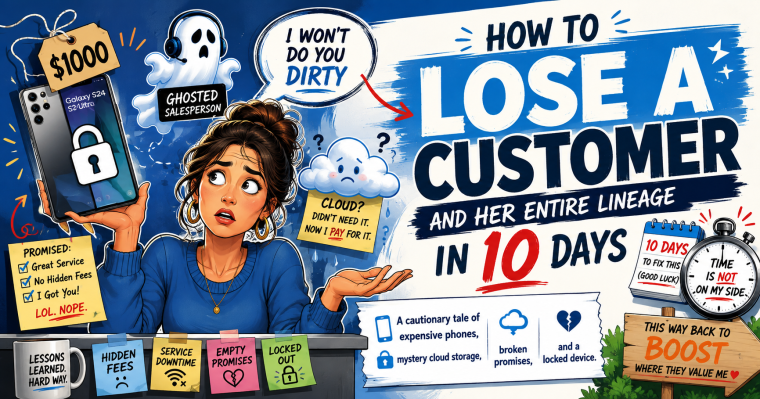
You probably know there was a movie called How to Lose a Guy in 10 Days. AT&T appears to have created the corporate version: How to Lose a Customer and Her Entire Lineage in 10 Days.
Here is the basic playbook.
When a customer tells you she specifically wants an inexpensive phone in the $200 to $250 range that she can toss around and not worry about, nod thoughtfully and then secretly sign her up for one of the most expensive phones you sell.
That is essentially how my relationship with AT&T began. I was perfectly happy with Boost Mobile. I paid exactly $60 a month total, including taxes and everything ( a great hotpot, visual voicemail, super reliable service). AT&T came to my home to install Wi-Fi, and they also sent a San Diego AT&T salesperson named Paul McGee, who convinced me to switch my phone service over to AT&T too.
The appeal for me was that my iPhone pissed me off on a daily basis and my past phone was the Galaxy. Buttttt… I explained to Paul exactly how I buy phones. I never want the latest and greatest expensive phone. I always buy an older model for around $200 to $250 because I want a phone I can toss around without feeling like I am carrying a Fabergé egg. Paul listened, nodded, acted like he completely understood what I meant, and then apparently signed me up for an approximately $1,100 Samsung Galaxy.
When the customer explains exactly what she wants, sell her the exact opposite without making the price particularly obvious.
Then we discussed cloud storage. I told Paul I already paid for iCloud and specifically asked whether switching to Samsung meant I would need some new Samsung cloud service. He told me, “No, no, no.” He said the phone had plenty of storage and I would not need a cloud.
Tell the customer she absolutely does not need a cloud service, then quietly add AT&T Personal Cloud to her account anyway.
I found that one later. Then when AT&T removed it, I started getting warnings about the cloud going away, which led to another round of trying to figure out whether anything had been stored there and whether I could lose data from a service I never knowingly asked for in the first place.
Paul also knew that I have a visual accessibility need. He knew I was relying heavily on what he was verbally telling me. He never offered to show me or walk me through the fine print in any way, let alone an accessible way. He repeatedly told me to trust him and told me that if anything looked wrong later, I should simply call him. (“That first bill might look too high because it takes a while for all the promos I gave you to attach. If anything looks wrong, just call me.”
Position yourself as the customer’s new best friend. Tell her to call, text, or email you anytime. Promise that you will personally take care of everything. Then disappear immediately after the sale.
Paul promised he would come back to my home for the iPhone trade-in. This is big part of why I got duped because I specifically told him I did not want to be running around to AT&T stores. I am caring for my very elderly dog, and the whole, “We do everything in home,” thing was part of the appeal.
Then Paul ghosted me.
Calls. Texts. Emails. Nothing. I even had my daughter try him because I wondered if something weird was happening with messages after switching from iPhone to Samsung. Nope. Apparently our close personal relationship had a very specific expiration date: the moment the sale went through.
Then came John from the Loyalty team in Reno. John moved me onto a 55+ plan. I had never heard of the plan and did not ask for it. He told me it would lower my costs, and while talking about everything he actually said, “I won’t do you dirty.”
I had to Google that phrase because, frankly, it sounds much more disgusting than it actually means.
And yet here we are.
You did me dirty, John.
You did me dirty.
John also told me to make sure I got my trade-in phone back within 30 days. He told me that as long as it turned on, get it in there on time.
Later, AT&T told me the 55+ plan JOHN PUT ME ON made me ineligible for the premium trade-in.
Move the customer onto a plan that supposedly disqualifies her from the trade-in while simultaneously telling her to hurry up and complete the trade-in.
Then I spoke with another AT&T representative, Marissa, who could see that I was on that plan and still told me that an iPhone 14 or newer would qualify. I had an iPhone 15. She told me to bring it to an AT&T store and make sure it turned on.
I have a recording of that conversation.
That became one of the recurring themes of this experience: AT&T employees would tell me something very clearly, I would rely on it, and then another AT&T employee would later explain that the thing I had just been promised was apparently impossible.
There were also the shipping labels.
AT&T loves promising shipping labels.
Tell the customer you are emailing the shipping label. Then simply do not email the shipping label.
Very efficient. No printer ink wasted.
Eventually I ended up in an AT&T store with my 17-year-old dog sleeping in a stroller, even though the original salesperson had specifically sold me on the idea that I would not have to go into a store.
The employee there, Ben, directed me into an online process that showed my iPhone going in for “up to $250.” Ben told me to ignore that. Ben was actually too terrible to write about in this blog post because I am trying to keep this one light and fun. In short, I didn’t want to hand the phone over to Ben without knowing that i was really getting the Samsung for free as promised numerous times.
So I called AT&T while standing inside the AT&T store.
That call connected me with Sharee, who finally started figuring out what was actually happening. She told me the phone was being processed as a $250 donation while Ben was standing there insisting it was not.
At this point, every person seemed to be working for a different imaginary version of AT&T.
Sharee also told me that the 55+ plan did not qualify for the trade-in, which directly contradicted what John and Marissa had told me.
(And these are only some examples. There were more calls, more promises, more contradictory information, more things that were supposedly going to be emailed, more waiting, and more employees who seemed completely unconcerned that any of this was happening.)
Eventually I had enough and decided to go back to Boost.
This brings us to one of my favorite parts of the story. (Not actually.)
I paid approximately $1,100 to AT&T for the Samsung specifically so I could leave AT&T and take the phone back to Boost.
The AT&T representative involved in that payment knew exactly why I was paying it off. I was leaving. I was taking my business back to Boost. That was the point.
When the customer pays approximately $1,000 for the phone specifically so she can leave your company and use the phone with another carrier, take the money and neglect to mention that the phone is still locked to AT&T.
So I went to Boost with my freshly paid-off approximately $1,000 Samsung Galaxy.
And could not use it.
It was locked.
I had to buy another phone.
You really cannot make this stuff up.
I paid AT&T approximately $1,000 for a phone so I could leave AT&T and use it at Boost, and then had to walk into Boost and buy a second phone because the first one was still locked to AT&T.
That is a remarkable customer-retention strategy.
I kept trying to escalate the situation. I eventually reached Roberta in the Chicago office and kept asking the same basic question: Who can actually make this right?
I was told employees could be reported. Cases could be submitted. Someone in a back office could review what happened. Maybe someone could be retrained.
That is wonderful for AT&T.
It did absolutely nothing for me.
If your employee gives me bad information that costs me $1,000, I really do not care whether that employee later gets coaching.
I wanted someone to say, “We screwed this up. Let me fix it.”
Instead, I was basically told there was no human being with the authority to look at the entire mess and actually fix the financial harm.
That lack of accountability might be the most disturbing part of the whole experience.
Every person was simply the next person in the chain. Paul could disappear. John could give me information that turned out to be wrong. Marissa could reinforce it. Ben could send me down another path. Sharee could discover the contradiction. Another employee could explain the policy. The back office could apparently review employees. Supervisors could apparently supervise attendance.
And somehow nobody could actually take responsibility for what happened to the customer.
My story is hardly unique. People warn each other about AT&T all the time. “Never go to AT&T.” “AT&T is dishonest.” “Watch your bill.” I even have a sweet elderly neighbor who became so upset after her own experience with an AT&T store that security ended up escorting her out.
At some point, when this many unrelated people have stories, companies should stop treating every complaint as an isolated difficult customer and start looking for the pattern.
And this is how you lose more than one customer.
My daughter was considering AT&T. She is now signup up with Spectrum instead for more money and less Gigs. My other kid went to Verizon. I went back to Boost even though my awesome old plan no longer exists. (If anyone is starting a class action to address this chicanery please lmk!!!!)
That is how you lose a customer and her entire lineage.
We hear constantly that AI is going to replace jobs alongside people on LinkedIn posting that AI can never replace humans where humanity matters.
I agree that humanity matters.
So what exactly are companies teaching their humans?
If the human contribution is lying to close a sale, giving contradictory information, disappearing after collecting a commission, adding things customers never asked for, promising emails that never arrive, leaving customers on hold for an hour, and finally telling them there is no human who can actually help, then “the human element” starts sounding like a very strange competitive advantage.
Maybe the question is less whether AI can replace humans and more whether companies are giving their employees permission to behave like decent humans in the first place.
Are they rewarded for honesty when honesty might lose a sale? Are they given enough authority to fix a mistake? Are they trained to care about the customer standing in front of them, or simply to complete the transaction and pass the problem to the next department?
Because AT&T felt like a house of cards built from exactly that kind of passing the problem along.
There are undoubtedly good people working there. If you are one of them, I hope you either help fix the system or find somewhere that deserves you.
Customers can tolerate mistakes.
What destroys trust is the lie, followed by another lie, followed by indifference, followed by an hour on hold, followed by someone explaining that the computer says there is nothing anyone can do.
Sometimes the most technologically advanced sentence a company can teach its employees is still the simplest one:
We screwed this up. Let me fix it.