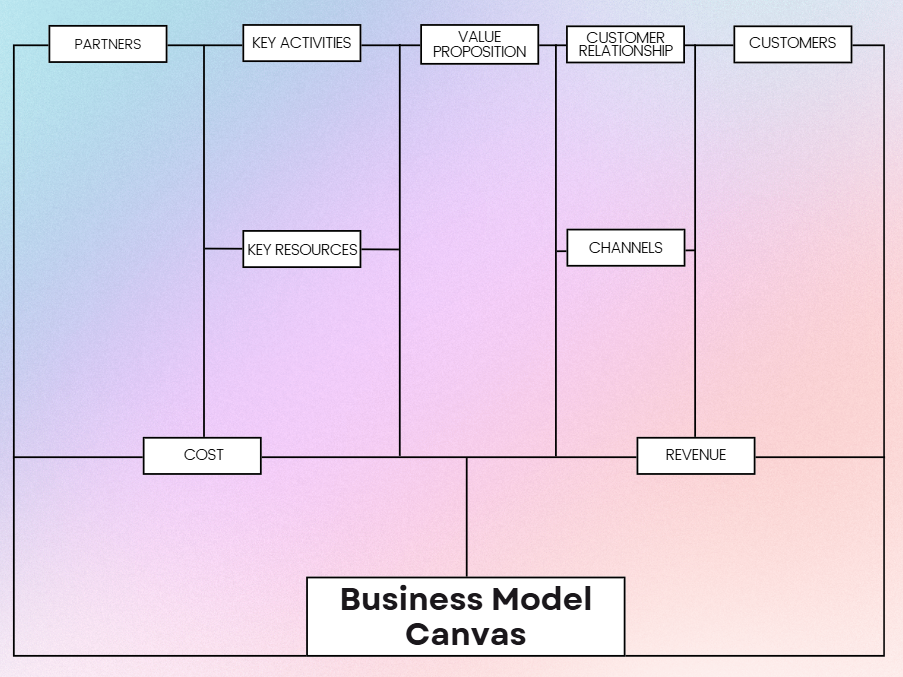
Contemporary research converges on a small set of core components that appear across most frameworks, even when terminology differs or when practitioners use tools such as the Business Model Canvas. To view/download examples, check out this post from SmartSheet.
The first element is the value proposition, which defines the specific benefits the enterprise offers and the problems or needs it addresses for customers. This element describes why a customer would choose one enterprise over another and sets quality, convenience, price, sustainability, or experience expectations. Studies that compare different models consistently rank the value proposition as a primary factor because it anchors other design choices and shapes required capabilities and partnerships.
The second element is customer segments, which specify the distinct groups of users or buyers the enterprise targets. Clear segmentation describes demographic, behavioral, and contextual characteristics and links each segment to a tailored value proposition. Empirical work on business model elements shows that the connection between value proposition and customer segments functions as a basic logic for the model, and that enterprises that clarify this connection early can build more coherent activity systems and revenue designs.
The third element is channels, which describe how the enterprise communicates with customers and delivers its value proposition. Channels cover marketing communication, sales interfaces, and delivery or fulfillment mechanisms across physical and digital touchpoints. Contemporary enterprises combine owned channels such as websites and stores with partner channels such as marketplaces or distributors. Channel choices now often reflect omnichannel strategies that integrate online and offline interactions in a single design.
The fourth element is customer relationships, which describe how the enterprise acquires, retains, and develops customers over time. Relationship designs range from highly personalized service to self-service and community-based interaction. In digital settings, relationship strategies increasingly rely on data-driven personalization, loyalty programs, and subscription mechanisms that stabilize demand and increase lifetime value. Research on modern business models highlights the role of communities and collaborative interactions as new relationship forms.
The fifth element is revenue streams, which specify how the enterprise receives payment from each customer segment. Traditional models depend on unit sales, while contemporary models use a mix of subscriptions, usage-based fees, freemium tiers, licensing, and performance-based contracts. Analysis of digital and platform-based enterprises shows that indirect revenues from advertising, data, or complementary services often complement or replace direct payments from end users.
The sixth element is key resources, which cover the most important assets needed to deliver the value proposition and operate the model. These resources include physical assets, human expertise, intellectual property, data, brands, and digital infrastructure such as platforms and analytics capabilities. Recent studies on intelligent manufacturing and service industries emphasize digital infrastructure, software, and data as central resources that shape feasible models and performance potential.
The seventh element is key activities, which describe the main actions the enterprise must perform to create and deliver value. These activities can include product development, production, logistics, customer support, software development, data analytics, and ecosystem orchestration. Contemporary research shows that digitalization changes the composition of key activities, with greater emphasis on software, platform management, and the integration of services with products.
The eighth element is key partnerships, which define external actors that contribute resources, activities, or access to customers and ecosystems. Partnerships include suppliers, distributors, platform operators, technology providers, and sometimes customers themselves in co-creation roles. Work on open and closed-loop business models shows how enterprises now integrate customers into design, usage, and end-of-life stages and collaborate horizontally across industries to deliver complex solutions.
The ninth element is cost structure, which summarizes the major cost categories associated with resources, activities, and partnerships. This structure indicates whether the model is more fixed-cost intensive, such as platform infrastructure, or variable-cost intensive, such as transaction-based service delivery. Digital business models often exhibit high fixed development and infrastructure costs with low marginal costs, which shifts emphasis toward scale, utilization, and network effects as economic drivers.
Contemporary enterprises often use this nine-element structure as a practical template, and many studies map real organizations against it to analyze their models. Global industrial companies have shifted from product-focused business models toward models that combine products with data-driven services delivered through digital platforms. Fashion and retail organizations experiment with subscription commerce, collaborative consumption, and AI-enabled design and forecasting, which change value propositions, revenue models, and key activities. Textile and apparel organizations adopt “as-a-service” models for mass customization, where networks of partners, digital resources, and advanced channels jointly deliver personalized offerings at reasonable cost and low inventory levels.
Digital enterprises such as platform operators illustrate how these elements combine in distinct ways. Their value propositions center on matching different user groups and enabling interactions, their customer segments include multiple sides such as consumers and complementors, and their revenue streams may depend on commissions, advertising, or data-based services. Their key resources emphasize software platforms and user data, their key activities revolve around ecosystem governance and algorithmic optimization, and their key partnerships include developers, content creators, and service providers that contribute to the platform’s attractiveness.
Across these different cases, the core elements of an enterprise business model are pretty consistent while their specific configurations adapt to technologies, markets, and regulatory conditions. Empirical studies and conceptual reviews underline that effective models make these elements mutually reinforcing and align them with strategy and organizational design. The enterprise business model therefore acts as a system-level blueprint that connects strategic choices with everyday operations and with the evolving expectations of customers, partners, and regulators. Here is the Business Model Canvas as an example:
References:
- Business Model Generation – Alexander Osterwalder, Yves Pigneur
- Business models, value capture, and the digital enterprise – David J. Teece, Greg Linden
- Business Models and Organization Design – Øystein D. Fjeldstad, Charles C. Snow
- The lens of business model element activation – Pavel Adamek
- Business model canvas in global enterprises”– B. Mičieta, Miroslav Fusko, Vladimíra Biňasová, Beáta Furmannová
- Business Models – Daniel J. Veit, Eric Clemons, Alexander Benlian, Peter Buxmann, Thomas Hess, Dennis Kundisch, Jan Marco Leimeister, Peter Loos, Martin Spann
- A Comprehensive Review and Investigation of Business Models – Alvin Lee
- THE IMPACT OF COVID-19 PANDEMIC ON CHANGING ENTERPRISE BUSINESS MODELS: TRENDS AND PROSPECTS – Oksana Pimenova, Kateryna Mamii
- Business Models and Modern Instruments for Improving the Efficiency of Retail Trade Enterprises – Nataliia Ivanchenko, Oksana Podskrebko, Viktoriia Mazur
- Business Model Innovation in the German Industry: Case Studies from the Railway, Manufacturing and Construction Sectors – Jan Winter
- Business Model Innovation for Sustainable Performance in Retail and Hospitality Industries – Siew H. Cheah, Yong H. Ho, Shiyu Li
- Digital solutions for bespoke apparel achieving mass customization in as service business models – Iasmina Dimcea, Diana Cozmiuc, Daniel Botez, Daniel Darvasi, Mircea Untaru, Ralf Wagner, Aurelian Țîțu
- Open Business Models and Closed-Loop Value Chains: Redefining the Firm-Consumer Relationship – Sebastian Kortmann, Frank T. Piller
0 Comments