Tasks 1–3 in the Strategic Alignment test domain in PMI’s Exam Content Outline for Portfolio Management describe a sequence that turns broad strategic direction (at the organizational level) into a ranked, operational framework for portfolio decisions.
TASK 1: Evaluate organizational strategic goals and objectives using document reviews, interviewing, and other information gathering techniques (e.g. market analysis) to understand the strategic priorities.
Task 1 evaluates organizational strategic goals and objectives to clarify strategic intent. Goals describe broad, qualitative aims, such as those relating to money, market position, service quality, or societal contribution. Objectives describe specific, measurable results over shorter horizons, such as defined improvements in performance indicators or customer outcomes. Accomplish X by Y date.
Strategic management research describes this hierarchy as linking long-term vision and mission to mid-term goals and near-term objectives in a structured chain. Tools such as SWOT analysis, strategy maps, or goal trees are used. Document review at this stage of the game identifies formal goals and objectives in strategic plans, business models, balanced scorecards, performance frameworks, and risk policies, risk appetite statement, and do forth.
Task 1 also interprets strategy in context. Strategy literature emphasizes that goals and objectives gain meaning only against the backdrop of the environment, stakeholders, and capabilities. Environmental scanning, including market and competitive analysis, regulatory review, and internal capability assessment, provides information on opportunities, threats, strengths, and weaknesses that shape which goals matter most over the planning horizon. Public and nonprofit strategy work uses structured processes that begin with clarifying mandates and mission, then move to systematic assessment of internal and external conditions, before identifying strategic issues and options for response. This diagnostic view positions portfolio management as a response to current conditions rather than a generic wish list. PMI is a fan of prompt lists like: PESTLE, TECOP, and SPECTRUM.
Task 1 uses stakeholder engagement to surface how different groups interpret goals and objectives. Stakeholder theory and strategic planning practice converge on the need to identify key stakeholder groups, map their interests and influence, and understand how they assess organizational success. Techniques such as structured interviews, focus groups, and facilitated workshops help elicit desired outcomes, perceived risks, and time preferences across stakeholders. Analytical approaches based on stakeholder salience or typologies of support and threat help differentiate stakeholder perspectives and clarify which interests must be reflected explicitly in strategic priorities. This analysis reveals tensions between goals, such as financial, ecological, or societal value, that later tasks must reconcile. For test prep, brush up on PMI’s favorite elicitation techniques.
Thanks to task 1 you truly understand your organization’s strategic priorities. Next let’s look at Task 3.
TASK 3: Rank strategic priorities working with key stakeholders and using qualitative and quantitative analyses in order to provide a guiding framework to operationalize the organizational strategic goals and objectives.
First we step back to deconstruct what they are saying here.
- The term “guiding framework” here corresponds to this structured representation of priorities. A guiding framework in portfolio research typically includes a small set of named value dimensions or strategic themes, their relative weights or tiers, and explicit rules that link them to project choices. Studies of strategic project ranking and infrastructure maintenance prioritization describe rules that determine when certain criteria dominate, such as safety, regulatory compliance, or resilience, and how trade‑offs among benefits, costs, and risks are handled. Research on investment project portfolios in infrastructure enterprises adds practical grouping rules, such as assigning projects to priority, optional, and prospective tiers, based on integrated scores from multi‑criteria scoring models.
- In decision‑analytic terms, to “operationalize” goals means to convert them into observable criteria, quantifiable scales, and consistent decision rules that govern selection, ranking, and resource allocation. Multi‑criteria portfolio studies describe operationalization as the definition of evaluation criteria, the development of scoring scales for each criterion, the assignment of weights that reflect ranked priorities, and the aggregation of scores into overall project or portfolio values. Research that combines ranking methods with optimization shows how these values feed into formal models that generate portfolios under budget, capacity, and dependency constraints, thereby embedding strategic priorities in actual funding and scheduling decisions.
- Note that they are calling out organizational strategic goals and objectives here.
Task 3 then, ranks strategic priorities to express what matters most now, given the organization’s intent and context. Strategic management research makes a distinction between listing goals and resolving trade-offs among them. Organizations often pursue multiple goals that cannot be maximized simultaneously, so decision makers need a method to articulate relative importance. A key difference between v3 of PMI’s standard and v4 is the section on value management. The standard now address the need to “negotiate portfolio value.” Part of this negotiation is the need to be REALISTIC.
Multi-criteria and goal-setting work provides methods for translating qualitative aims into ordered priorities and weights. Techniques such as pairwise comparison, Analytic Hierarchy Process, or other multi-criteria decision methods support structured comparison among strategic objectives or themes, using consistent scales and internal consistency checks. Other techniques, such as risk–return charts or zero-based prioritization of themes, synthesize both qualitative judgments and quantitative estimates to create ranked sets.
Task 3 also requires collaboration with key stakeholders — here we need to create shared priorities. Research on strategic planning processes in public, nonprofit, and private organizations highlights the importance of engaging governing bodies, senior managers, and representative stakeholders in structured deliberation. Methods such as strategy mapping, facilitated ranking exercises, or Delphi-like consensus building help participants discuss causal links between objectives, identify dependencies, and test the implications of emphasizing one objective over another. Studies of balanced scorecard and strategy maps show that visualizing relationships among financial, customer, internal process, and learning objectives helps decision makers understand how project portfolios contribute to higher-level aims.
By the end of Task 3, the organization holds an explicit, debated, and agreed ordering of strategic priorities, usually expressed as weighted objectives, strategic themes, or key value dimensions. This will help us with Task 2.
Task 2: Identify prioritization criteria (e.g., legislative, dependencies, ROI, stakeholder expectations, strategic fit) using information gathering and analysis techniques in order to create a basis for decision making.
- Decision-making here implies decisions regarding potential components/components within the portfolio.
Task 2 defines prioritization criteria and builds the portfolio scoring model using the ranked priorities from Task 3 as input. Portfolio decision analysis research models value as a function of how projects contribute to a set of weighted objectives or criteria. Task 2 translates high-level priorities into operational criteria, such as strategic alignment, expected benefits, risk exposure, time urgency, regulatory obligations, interdependencies, and stakeholder impact. Strategic planning and performance management literature notes that good criteria are specific, measurable, and linked to key success factors and performance indicators, often drawing on frameworks such as the balanced scorecard or key performance indicator hierarchies. Some criteria describe mandatory conditions, such as legal or safety compliance, which define admissibility rather than relative desirability.
Task 2 then specifies a prioritization model that integrates these criteria. Single-criterion ranking may apply where one factor dominates, such as mandatory compliance or survival-oriented financial indicators. More often, multiple-criteria ranking and scoring models describe portfolio decisions better, because portfolios must balance financial, strategic, risk, and learning dimensions. Multi-criteria decision analysis frameworks and scoring models define scales for each criterion, assign weights based on Task 3’s ranked priorities, and describe how to combine scores into an overall measure of contribution to strategic value. Some approaches use linear additive models, while others use more advanced methods that capture interactions or thresholds among criteria. Case studies in project portfolio selection demonstrate how these models align project rankings with strategy and stakeholder preferences, and how they can be extended to optimization models that consider budget and resource constraints.
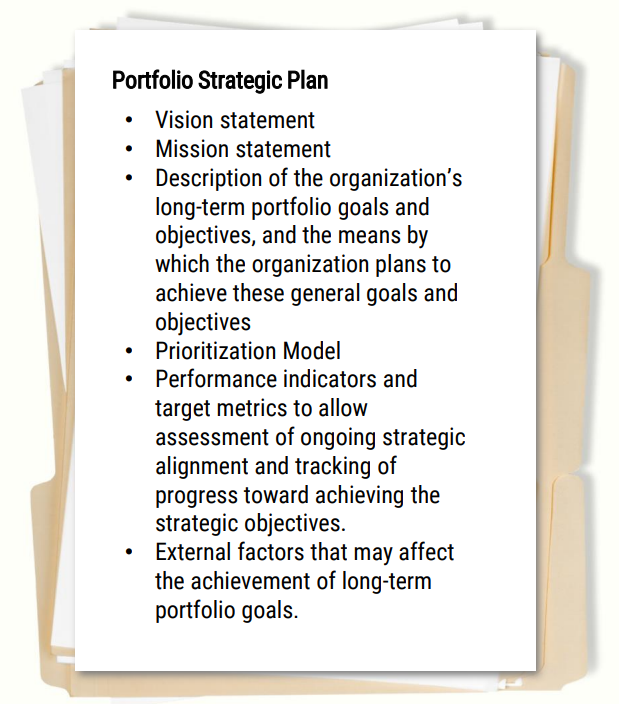
Tasks 1–3 contribute directly to the Portfolio Strategic Plan, which acts as both a guidepost and a bridge between high-level strategy and actionable portfolio management.
- Task 1 assesses the organization’s strategic intent by reviewing goals, priorities, and environmental factors
- Task 3 ranks the strategic priorities to reflect what matters most right now
- Task 2 defines the prioritization criteria and builds the scoring model to guide decision making
In case you are wondering about the order here: The ECO is not listing portfolio manger tasks in order. If you run Task 2 before Task 3, you would be defining criteria and weights before you have an explicit agreement on relative strategic priorities, which undercuts the logic PMI describes for negotiation of value and strategic alignment.
References:
- PMI’s Standard for Portfolio Management, v3 and v4
- Organizational strategic planning, implementation and evaluation with analysis of challenges and benefits for profit and nonprofit organizations – Moses Waithanji Kabeyi
- Strategic Planning for Public and Nonprofit Organizations: A Guide to Strengthening and Sustaining Organizational Achievement – John M. Bryson
- Understanding goal formation in strategic public management: a proposed theoretical framework – John M. Bryson, Bert George, Dan Seo
- Strategic Management for Public and Nonprofit Organizations – Jack Rabin, Gerald J. Miller, W. Bartley Hildreth, Alan W. Steiss
- Strategic Management: Concepts and Cases – Arthur A. Thompson, A.J. Strickland
- A strategic management framework of tangible and intangible assets – Marco Greco, Luigi Cricelli, Massimo Grimaldi
- Value Management in Project Portfolios: Identifying and Assessing Strategic Value – Minna Martinsuo, C. P. Killen
- A DEMATEL-based method for prioritizing strategic projects using the perspectives of the Balanced Scorecard – Luis Quezada, Héctor A. López-Ospina, César Ortiz, Andrés Oddershede, Patricio Palominos, Paulina A. Jofré
- Prioritization of key performance indicators: An integration of analytical hierarchy process and goal setting – Arash Shahin, Mahsa Ali Mahbod
- A Comprehensive System to Support Decision Making in Highly Complex Project Portfolio Situations – Efraín Solares, Eduardo Fernández, Carlos A. Coello Coello, Xóchitl Segura Lozano, Reimundo Moreno-Cepeda, Raymundo Díaz
- An integrated approach for prioritizing the strategic objectives of balanced scorecard under uncertainty – Farshid Farrokhi Jahantigh, Behnam Malmir, Behzad Aslani Avilaq
- Priority goals for the strategic development of industrial enterprises based on sustainable marketing – Yulia Medvedeva, Maria Kolgan, Maksim Pasholikov, Yuriy Shevyakov, Alisa Sidorenko
- Strategies for assessing and managing organizational stakeholders – Gary T. Savage, Timothy W. Nix, Carlton J. Whitehead, John Blair
- Strategic Alignment and Value Optimization: Unveiling the Critical Role of Project Portfolio Management for a Flexible Environment – Francisco I. Rodrigues Coelho, Flávio Bizarrias, Rodrigo Rabechini Junior, Cristiana D. P. Martens, Maurício Martens