In prior posts I covered portfolio strategic design and the prioritization model (pre‑component). These addressed:
- Vision, goals, objectives, and strategic themes are all defined
- The prioritization model is designed: criteria, weights, and decision rules are derived from strategy
- A high‑level portfolio concept and business model are also created
Here we will start looking at component‑level portfolio construction
- Task 4 builds a portfolio component inventory consistent with the strategic theme: a screened list of real and potential initiatives with applicable data
- Task 5 uses that component inventory, together with the prioritization model, to construct and test scenarios
- Task 6 recommends a scenario (or more) and will add the approved scenario to the Portfolio Charter (which will then be authorized to make the portfolio official)
Tasks 4–6 in the Strategic Alignment test domain in PMI’s Exam Content Outline for Portfolio Management describe a progression from defining the portfolio’s contents to recommending a structured, authorized portfolio. Each task works with different decision questions, data structures, and analysis techniques, so the sequence matters for coherence and governance.
Vision, goals, objectives, and strategic themes are defined.
The prioritization model is designed: criteria, weights, and decision rules are derived from strategy.
Task 4: Identify existing and potential portfolio components by reviewing documentation such as business plans/proposals in order to create portfolio scenarios.
When assessing an existing portfolio, the Portfolio Management Information System (PMIS) provides a comprehensive list of components, along with key details such as dependencies, level of effort, points of contact, and dashboard-style metrics. When a portfolio is in its early stages of development, PMI refers to this as “immature and evolving.” You can think of the portfolio as a list of components. This list may be in its infancy (it will evolve), it may be a list of “qualified” components, it will ultimately become an “authorized” portfolio, and components will need to be “authorized” as well. Now, if you are setting out to initiate a new portfolio, you will need to investigate and put together an inventory of work — a list of active (disparate) work that may be potential portfolio components. Developing an inventory of active work helps ensure that only initiatives aligned with strategic objectives are considered for selection and prioritization, forming the foundation of an effective portfolio. Additionally, to identify potential portfolio components, review business cases, project proposals, feasibility studies, and proofs of concept (POCs). This way you can assess the potential value, risks, and resource needs of these contenders. This sets the stage for Task 5, where possible portfolio scenarios are developed based on what’s been identified.
Task 5: Create portfolio scenarios (what-if analysis) by reviewing components against prioritization criteria and using analysis techniques (e.g., options analysis, risk analysis, SWOT analysis, financial analysis) in order to evaluate and select viable options.
Task 5 focuses on creating portfolio scenarios through what‑if analysis. The aim here is to compare different configurations of components against agreed prioritization criteria and constraints. The portfolio manager constructs scenarios that represent alternative ways to combine and stage components, then evaluates each scenario in terms of strategic alignment, risk exposure, resource use, and expected benefits.
Options analysis compares configurations by examining their contribution to objectives and by testing alternative combinations of components. Risk analysis and sensitivity analysis test how uncertainties in assumptions and external conditions affect scenario performance. SWOT analysis examines strengths, weaknesses, opportunities, and threats across scenarios, linking internal capabilities to external drivers. Financial analysis uses measures such as ROI, NPV, and ENPV to quantify financial performance under both deterministic and probabilistic views. Feasibility assessments examine whether scenarios can be implemented with available capacity, governance, and operating structures. The output of Task 5 is a set of viable portfolio scenarios with quantified trade‑offs and documented assumptions.
These scenarios will be used in Task 6, where a recommendation is made to the governing body.
Task 6: Recommend portfolio scenario(s) and related components, based on prioritization analysis/criteria, in order to provide governance with a rationale for decision making.
Task 6 takes those analyzed scenarios and turns them into a structured recommendation for the governing body. The aim here is to recommend portfolio scenario(s) and related components based on the prioritization model and the results of Task 5. The Portfolio Strategic Plan provides context by expressing the organization’s strategic goals, value drivers, and prioritization logic.
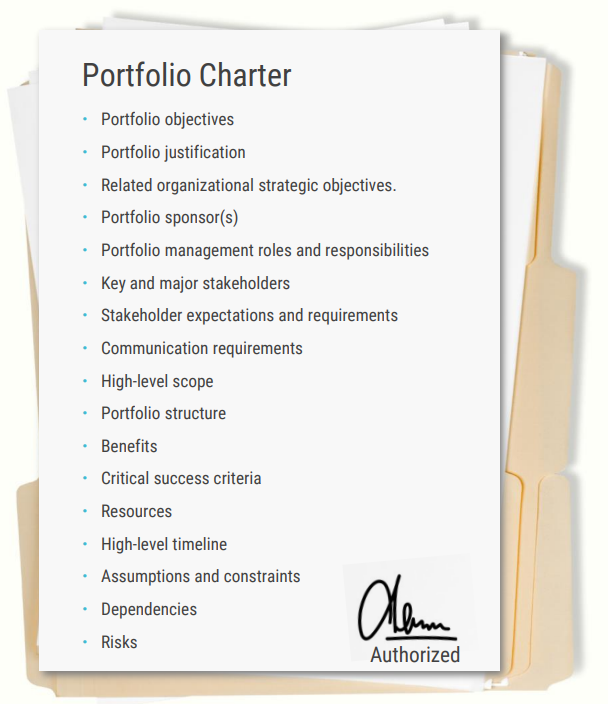
The Portfolio Charter provides the formal authorization of the selected scenario by defining portfolio structure, scope boundaries, governance arrangements, roles, timelines, and high‑level resource commitments. During Task 6, the portfolio manager compares candidate scenarios in a way that highlights strategic alignment, resource constraints, risk profiles, interdependencies, and expected benefits. This comparison helps governance bodies decide which components to fund, defer, or remove. Portfolio structure is defined as the way projects, programs, and operational work are grouped and organized to achieve strategic objectives. Task 6 links the recommended structure to the scenario analysis outcomes, so that the approved Portfolio Charter captures both the selected components and their organization into value‑oriented groups, categories, and tiers. The result is a recommendation that gives governance a clear, evidence‑based rationale and a documented, authorized portfolio structure.
References:
- Sustainability risk and portfolio management—A strategic scenario method for sustainable product development – Villamil, Schulte, Hallstedt
- Scenario-based portfolio model for building robust and proactive strategies – Vilkkumaa, Liesiö, Salo, Ilmola-Sheppard
- Portfolio decision analysis: Recent developments and future prospects – Liesiö, Salo, Keisler, Morton
- A Comprehensive System to Support Decision Making in Highly Complex Project Portfolio Situations – Solares, Fernández, Coello Coello, Segura Lozano, Moreno-Cepeda, Díaz
- Unlocking the potential of project portfolio: value-oriented interactive risk management – Bai, Zhang, Zhang, Shao, Luo
- Scenario-based optimization robust model project portfolio selection under risk considerations – Ramedani, Didehkhani, Mehrabian
- A real options methodology for multi-stage project selection: an application to NASA’s SBIR program – Belz, Eckhause, Terrile, Zapatero
- A methodology for strategy-oriented project portfolio selection taking dynamic synergy into considerations – Bai, Bai, An
- Prospective scenarios applied in course portfolio management: An approach in light of the Momentum and ELECTRE-MOr methods – Mellem, de Araújo Costa, de Araújo Costa, Moreira, Simões Gomes, dos Santos, de Pina Corriça
- Structuring prospective scenarios for project portfolio selection in a junior consulting company – Terra, Rocha, Braga, Moreira, Gomes, Santos, de Araújo Costa, Pereira
- Robust Project Portfolio Selection towards Organizational Resilience: Post-COVID Perspective – Mahmoudi, Abbasi, Deng
- Portfolio design for investment companies through scenario planning – Hanafizadeh, Kazazi, Bolhasani
- Project portfolio management as a tool for implementing an organization’s strategy: development of a project selection and ranking system – Simionova, Simionov