Knowledge management on projects aims to maintain team capability and transfer learning into future work. Projects benefit when they access what others already know and when they retain what the team discovers during delivery. Effective practice focuses on making knowledge accessible, usable, and reusable across project phases and across the organization.
Knowledge management supports performance when it enables timely access to relevant insights. Teams need information and know‑how at the moment of decision, not months later in an archive. This requires attention to both how knowledge is captured and how it is retrieved, filtered, and applied in predictive, adaptive, and hybrid environments.
Project knowledge management operates in a remote and hybrid world where collaboration patterns change. Distributed teams rely heavily on digital tools, which can either support or hinder knowledge sharing depending on how teams design communication norms, choose channels, and structure information. Remote work amplifies long-standing challenges such as fragmented documentation, inconsistent practices, and knowledge hoarding.
Project leaders treat knowledge as organizational intellectual capital. Their role includes turning individual expertise and project experience into persistent value for current team members, for future projects with similar characteristics, and for the wider organization. This value emerges through deliberate practices that encourage both contribution and reuse.
Psychological safety and trust provide the social conditions for knowledge sharing. Team members contribute more knowledge when they feel respected, fairly treated, and protected from ridicule or punishment for mistakes. Leaders who model transparency, admit uncertainty, and invite questions create conditions that increase both explicit and tacit knowledge flow.
Empowerment in knowledge management requires specific, observable practices. Leaders can grant time for mentoring and peer coaching, authorize people to update knowledge bases, and recognize contributions to communities of practice. They can also clarify decision rights for how standards, playbooks, and patterns are created, maintained, and retired.
Knowledge on projects exists in explicit and tacit forms. Explicit knowledge is codified content that is easy to document in wikis, repositories, diagrams, or standard operating procedures. Tacit knowledge resides in people’s experiences, intuitions, mental models, and subtle pattern recognition that are harder to articulate.
Explicit knowledge supports repeatability and scale. Checklists, templates, reference architectures, test catalogs, and configuration guides enable teams to apply proven approaches quickly. In predictive and hybrid contexts, these artifacts help standardize planning, estimating, and reporting across projects and programs while still allowing contextual tailoring.
Tacit knowledge drives judgment in ambiguous or novel situations. Teams surface tacit knowledge through techniques such as pair work, shadowing, communities of practice, technical reviews, after‑action reviews, and structured storytelling. In adaptive environments, frequent interactions such as backlog refinement, mob programming, and product discovery workshops give tacit understanding a channel to influence decisions.
Consider too that trust has both task-based and interpersonal dimensions. Task-based trust arises when people consistently deliver on commitments and demonstrate competence. Interpersonal trust arises when people feel known as individuals and expect goodwill from colleagues. Project leaders strengthen interpersonal trust by creating opportunities for informal interaction, cross-functional collaboration, and shared problem solving.
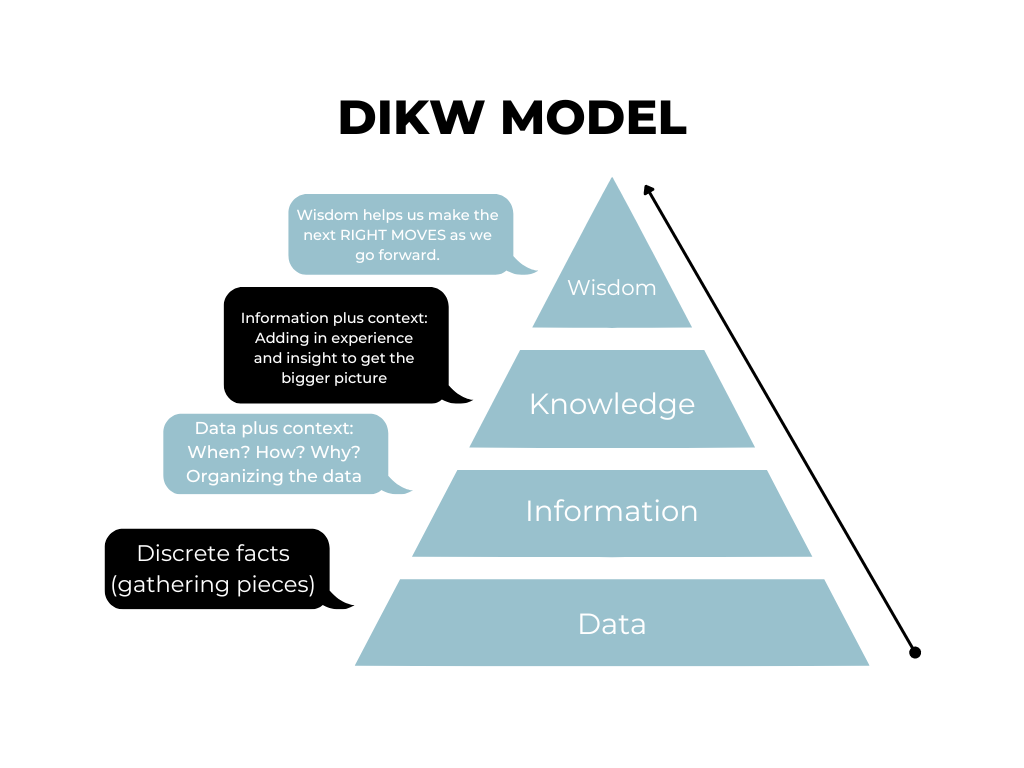
The DIKW (Data–Information–Knowledge–Wisdom) model offers a useful scaffold: Data represents raw observations, such as metrics, logs, or survey responses. Information emerges when context such as who, what, where, and when gives data meaning. Knowledge develops when experience, interpretation, and pattern recognition connect pieces of information into actionable understanding. Wisdom guides forward-looking choices about what to do next under uncertainty.
Predictive project environments often produce large volumes of structured data and documentation. Teams translate this material into knowledge through analysis of baselines and variances, trend reviews, and lessons-learned sessions. Hybrid environments can apply DIKW thinking by combining predictive performance data with adaptive feedback from experiments and user interactions.
Knowledge management spans multiple levels: individual, team, project, and organization. Individual knowledge includes personal expertise and learning histories. Team knowledge covers shared norms, practices, and mental models. Project knowledge extends to cross-team coordination mechanisms, integration patterns, and contextual constraints. Organizational knowledge aggregates reusable assets such as frameworks, standards, and domain-specific insights.
Service management concepts such as Knowledge-Centered Service align well with project knowledge needs. The Solve Loop focuses on operational use: capturing knowledge as a by‑product of execution, structuring it in consistent formats, reusing it to solve recurring problems, and continuously improving it based on feedback. The Evolve Loop focuses on systemic learning: analyzing patterns in knowledge use and gaps to drive process, tool, or capability changes.
In predictive projects, Solve Loop practices can be integrated into governance events. For example, risk reviews, technical design boards, and phase-gate meetings can require the creation or update of specific knowledge artifacts. Evolve Loop thinking can guide periodic portfolio-level reviews that examine how lessons from multiple projects inform standards, training, and resourcing.
In adaptive and hybrid environments, knowledge practices fit naturally into cadence events. Sprint reviews, retrospectives, and release planning sessions can explicitly generate or update knowledge items. Product discovery and experimentation logs can feed a knowledge base that documents which hypotheses were tested, which patterns worked, and which contexts limit applicability.
Effective knowledge management requires clear processes for capturing, structuring, reusing, and improving content. Capture mechanisms need to be lightweight enough to fit into daily work, such as adding a short “knowledge note” to a ticket, updating a pattern catalog during a design session, or recording a brief annotated demo. Structure standards define fields, tags, and templates so that contributors and consumers can navigate consistently.
Reuse depends on searchability, relevance, and trust in the content. Teams benefit from taxonomies that reflect how practitioners think about their work, such as by domain, technology stack, process area, or risk type. Ratings, review histories, and ownership metadata increase confidence that artifacts are current and applicable. In adaptive settings, teams also need to see applicability limits, such as environment constraints or user segment specifics.
Improvement processes keep knowledge current and avoid clutter. Scheduled curation cycles, ownership assignments for key artifacts, and usage analytics help focus effort on content that matters. When teams deprecate outdated practices, they can redirect consumers to newer, evidence-based patterns and record the rationale behind the change.
Several principles guide human behavior in knowledge sharing. People decide whether to contribute based on perceived fairness, recognition, effort required, and personal risk. They rarely share everything they know, and much of what they know becomes available only in relevant situations. Contextual triggers, such as particular problems or stakeholder requests, often surface previously latent knowledge.
Psychological barriers such as fear of losing status, discomfort with uncertainty, or prior negative feedback reduce knowledge sharing. Abusive or dismissive leadership further undermines psychological safety and lowers willingness to share insights, especially when the knowledge exposes mistakes or challenges existing decisions. Healthy cultures treat errors as learning opportunities and invite critical reflection without blame.
Project leaders can model desired behavior by sharing their own learning, asking open questions, and acknowledging when others’ knowledge improves outcomes. They can also formalize recognition for knowledge contributions in performance discussions, promotion criteria, and informal praise. In cross-functional settings, public appreciation of collaborative problem solving reinforces norms of openness.
Formal and informal mechanisms both matter. Formal mechanisms include lessons-learned registers, knowledge bases, standards libraries, and structured communities of practice. Informal mechanisms include mentoring, peer networks, social chats, and cross-team working groups. Organizations that balance both types increase the chance that knowledge flows across boundaries between projects and permanent structures.
Governance of knowledge management connects project work to organizational memory. A project management office or similar function can define minimum expectations for knowledge capture, create shared repositories, and curate cross-project insights. At the same time, teams need autonomy to adapt formats and practices to their specific context so that knowledge work remains meaningful and sustainable.
Virtual and hybrid teams need specific attention to digital communication and collaboration practices. Clear channel strategies, media-rich tools for complex topics, and norms for response times help reduce friction and misinterpretation. Camera use, visual collaboration boards, and occasional face-to-face or high-bandwidth sessions can support tacit knowledge exchange that is hard to achieve through text alone.
Knowledge management also supports decision quality on projects. Decision-makers benefit when they receive the right information at the right time, when they can access it from multiple locations and devices, and when systems provide alerts for deviations that demand attention. Good knowledge practices filter noise, highlight what matters, and trace decisions back to the evidence and reasoning behind them.
Predictive, adaptive, and hybrid approaches can all integrate decision support into their knowledge systems. Predictive environments often rely on dashboards, variance analyses, and scenario modeling that draw on historic knowledge. Adaptive environments may use experiment repositories, user research libraries, and real-time telemetry to guide product decisions. Hybrid environments can connect both forms to support governance and agility.
Knowledge management contributes to project success when it links daily work with long-term organizational learning. By combining psychological safety, structured processes, supportive technology, and deliberate leadership behaviors, project teams maintain team capability and transfer what they learn into future efforts. This creates a dynamic organizational memory that adapts as contexts, technologies, and strategies evolve.
References
- Shared leadership and project success: The roles of knowledge sharing, cohesion and trust in the team – Hassan Imam, Muhammad Kashif Zaheer
- Knowledge sharing mechanisms and techniques in project teams: Literature review, classification, and current trends – N. Navimipour, Yeganeh Charband
- Knowledge-Sharing Culture, Project-Team Interaction, and Knowledge-Sharing Performance among Project Members – Guodong Ni, Qingbin Cui, Linhua Sang, Wen-shun Wang, Dongchun Xia
- Do the Project Manager’s Soft Skills Foster Knowledge Sharing? – Inês Avença, Luísa Domingues, Helena Carvalho
- Psychological Safety Effects on Knowledge Sharing in Project Teams – Upasna A. Agarwal, V. Anantatmula
- Social Practices and the Management of Knowledge in Project Environments – Mike Bresnen, Linda Edelman, Sue Newell, Harry Scarbrough, Jacky Swan
- How Project Knowledge Management Develops Volatile Organizational Memory – A. Versiani, Pollyanna de Souza Abade, Rodrigo Baroni de Carvalho, Cristiana Fernandes de Muÿlder
- Challenges and Critical Success Factors of Digital Communication, Collaboration and Knowledge Sharing in Project Management Virtual Teams: A Review – Kurt Swart, Thea Bond-Barnard, Ritesh Chugh
- The Value of Knowledge Sharing: Impact of Tacit and Explicit Knowledge Sharing on Team Performance of Scientists – Bojan Obrenovic, Slobodan Obrenović, Akmal Hudaykulov
- Knowledge Management in Projects – L. Pereira, José Santos, Ângela Dias, Rui Costa
See also: