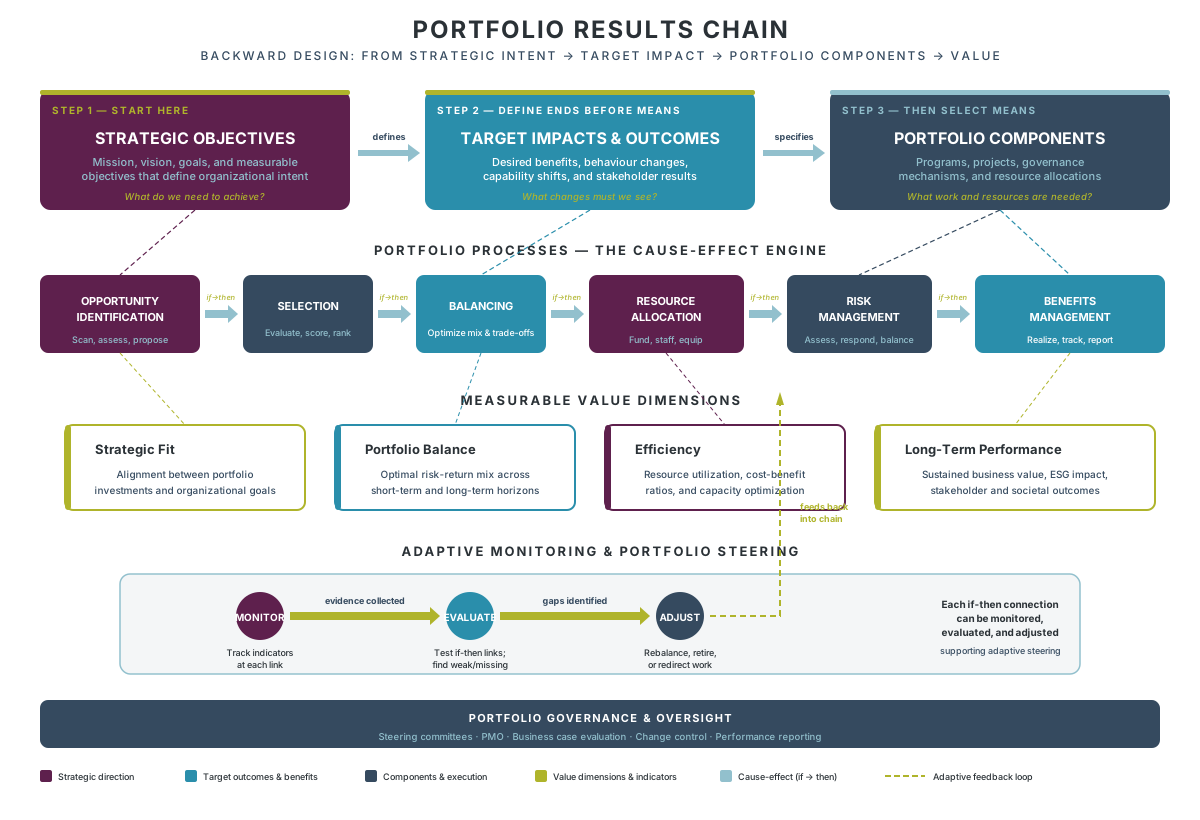
(Right-click and open in a new tab to enlarge)
Most organizations are full of well-intentioned work that never quite adds up. Projects finish on time, budgets hold, deliverables get checked off, and yet the org’s strategic intent barely comes to life. The gap between “we did the work” and “we got the value” is real, and it is expensive. A results chain is the tool that exposes where that gap lives and what to do about it.
What a Results Chain Actually Is
A results chain is a structured, testable explanation of how portfolio investments are expected to deliver value. The chain starts with a defined strategic objective and traces a sequence of cause-and-effect links — from funded initiatives through intermediate results to final benefits. Each link is framed as a conditional relationship: if a specific action or output occurs, then a particular outcome should follow, given defined conditions. The entire structure forces a portfolio team to state its theory of change in clear, observable steps that connect organizational strategy to project work.
To put this in Business Fractals™ terms, a results chain maps the D.R.↓.V.E. cascade from DIRECT (the big WHATs — vision, goals, objectives) through ROUTE and IMPLEMENT (the big HOWs and the detailed plans) all the way to EMPOWER + DELIVER (where outputs become outcomes, outcomes become benefits, and benefits become realized value). The chain gives you a visible, testable thread from intent to impact. When something breaks, you can see exactly where.
The Backward-Design Logic
A well-built results chain does not start with the projects and work backward to see if they happen to support strategy. The logic runs the other direction. Strategic objectives are defined first. Target value and benefits are specified next. The chain then asks what outcomes are needed to create those benefits, what capabilities are needed to produce those outcomes, and what outputs are needed to build those capabilities. Only at the end of this sequence does the chain identify which portfolio components should be selected to produce those outputs.
This backward-design logic matters because it prevents a common failure mode: selecting projects based on enthusiasm, familiarity, or internal politics and then retroactively claiming strategic alignment. When the chain starts from the end state and works backward, every component in the portfolio must justify its existence against a stated expected contribution. Components that cannot demonstrate a plausible if–then link to a desired outcome have no business consuming resources.
The Cause-and-Effect Engine
Between strategy and value sits a series of portfolio processes, each connected to the next by testable if–then logic. The chain links opportunity identification, selection, balancing, resource allocation, risk management, and benefits management to measurable value dimensions like strategic fit, portfolio balance, efficiency, and long-term business performance.
Each of these processes has a job to do in the chain. Opportunity identification scans for potential investments that align with strategic objectives. Selection evaluates, scores, and ranks those candidates. Balancing optimizes the portfolio mix across risk-and-return trade-offs, short-term and long-term horizons, and component types. Resource allocation assigns human, financial, and asset capacity to the selected components. Risk management assesses and responds to threats and opportunities across the portfolio. Benefits management tracks whether the expected gains are actually materializing.
When each process feeds the next with clear, conditional logic, the portfolio operates as a connected system rather than a loose collection of projects. When one link weakens — say, balancing is neglected and the portfolio skews heavily toward low-risk, low-return work — the chain makes that weakness visible before it compounds into a strategic shortfall.
Assumptions Live Between the Links
Every if–then connection in a results chain rests on assumptions. The chain makes those assumptions explicit rather than leaving them buried in business cases that no one revisits after approval.
For example, the link between “portfolio component” and “output” assumes that resources will be allocated and that scope will remain controlled. The link between “output” and “capability” assumes that the deliverable will be fit for purpose and that the organization can absorb it. The link between “capability” and “outcome” assumes that stakeholders will actually use the new capability and change how they work. The link between “outcome” and “benefit” assumes that behavioural change will sustain long enough to generate measurable gains. The link between “benefit” and “value” assumes that external conditions — market dynamics, regulatory shifts, competitive pressures — will remain favourable enough for the benefits to matter.
Naming these assumptions is where the results chain earns its keep. A portfolio team that can articulate “this link depends on stakeholder adoption of the new process within six months” has something it can monitor, test, and respond to. A portfolio team that simply assumes adoption will happen has a plan built on hope.
Adaptive Steering, Not Set-and-Forget
A results chain is a living reference model, not a static diagram. Each if–then connection can be monitored, evaluated, and adjusted when evidence shows weak or missing links. This capacity for adaptive steering is what separates a results chain from a one-time planning exercise.
Monitoring means tracking indicators at each stage of the chain — from strategic KPIs at the top to deliverable quality, adoption rates, process metrics, and benefits realization at the bottom. Evaluating means testing the if–then logic against observed data: Did the expected output actually appear? Did stakeholders adopt it? Did the anticipated outcome follow? Adjusting means rebalancing the portfolio, retiring components that are not contributing, or redirecting resources to strengthen weak links.
Over time, evidence about which links hold and which fail allows teams to refine their theory of change and improve portfolio practices. Patterns that emerge across multiple chains can inform revisions to organizational design, governance, and capability development. The results chain becomes a learning device — a way for the portfolio organization to get smarter about how it converts investment into value.
How This Snaps into the Business Fractals
If you already hold the D.R.↓.V.E. Success™ fractal in your mind, results chains snap right into place. The DIRECT focus sets the strategic objectives that anchor the top of the chain. The ROUTE focus defines the broad approach — the portfolio strategy, the selection criteria, the balancing logic. The IMPLEMENT focus authorizes specific components and allocates resources, spinning off D.R.↓.V.E. fractals at the program and project levels. The VALIDATE/ADAPT focus is where the monitoring, evaluating, and adjusting happens — testing if–then links, raising exceptions when assumptions fail, and feeding evidence back up the chain. EMPOWER + DELIVER is where the chain’s promise becomes real: outputs enable outcomes, outcomes enable benefits, and benefits contribute to value realization.
The results chain also highlights something that the fractal already teaches: every level of the organization participates in the same pattern. A portfolio-level results chain traces the path from organizational strategy to portfolio value. A program-level results chain traces the path from program objectives to coordinated benefits. A project-level results chain traces the path from project deliverables to enabled outcomes. The pattern repeats. The scale changes. The logic stays the same.
Value Dimensions the Chain Delivers To
The chain does not produce a single abstract number called “value.” It connects portfolio processes to specific, measurable value dimensions that matter to the organization.
Strategic fit measures the alignment between portfolio investments and organizational goals. A chain that starts from strategic objectives and traces each link down to funded components makes strategic fit visible and testable rather than aspirational.
Portfolio balance measures whether the mix of investments is optimized across risk-and-return profiles, time horizons, and component types. The chain shows where the portfolio is over-concentrated or under-diversified and supports trade-off decisions.
Efficiency measures resource utilization, cost-benefit ratios, and capacity optimization. The chain exposes where resources are producing value and where they are absorbed without contributing to downstream outcomes.
Long-term business performance measures sustained impact — financial results, stakeholder outcomes, ESG contributions, and durable capability development. The chain connects short-term outputs to longer causal pathways, embedding resilience and sustainability as explicit end states rather than afterthoughts.
What Governance Has to Do with It
Results chains work within broader organizational project management structures. Governance bodies — steering committees, project management offices, executive sponsors — can use the chain as a common reference when evaluating business cases, monitoring performance, and adjusting structures and processes.
Because the chain clarifies how portfolio-level routines (risk management, change management, resource allocation, stakeholder engagement) are expected to influence outcomes, it supports a more integrated treatment of portfolios, programs, and projects as parts of one system oriented toward strategy execution. Governance stops being a compliance checkpoint and starts being a steering mechanism — one with a clear line of sight from every decision to its expected contribution.
The Bottom Line
A results chain gives a portfolio team a structured, testable, and adaptive way to connect strategy to value. It replaces vague claims of alignment with explicit cause-and-effect logic. It surfaces assumptions that would otherwise stay hidden. It provides indicators for monitoring and a framework for adjusting when reality diverges from the plan. And it does all of this within a pattern — backward design from strategic objectives through target value, outcomes, capabilities, and outputs to the portfolio components selected to produce them — that repeats at every level of the organization.
For anyone who has already seen the fractal, this all makes sense. The results chain is one more concept that snaps into the scaffold you already carry. For anyone who has not yet seen the fractal, the results chain is an excellent place to start noticing it.
References
“Results Chains: A Tool for Conservation Action Design, Management, and Evaluation” — R. Margoluis, C. Stem, V. Swaminathan, M. Brown, A. Johnson, G. Placci, N. Salafsky, I. Tilders
“The Holy Grail of Biodiversity Conservation Management: Monitoring Impact in Projects and Project Portfolios” — P. Stephenson
“Development of a New Business Model to Measure Organizational and Project-Level SDG Impact — Case Study of a Water Utility Company” — P. Mansell, S. P. Philbin, T. Broyd
“The Management of Project Management: A Conceptual Framework for Project Governance” — E. G. Too, P. Weaver
“Modeling Organizational Project Management” — R. Müller, N. Drouin, S. Sankaran
“Organizational Project Management: Theory and Implementation” — R. Müller, N. Drouin, S. Sankaran
“Strategic Alignment and Value Optimization: Unveiling the Role of Project Portfolio Management for a Flexible Environment” — F. I. Rodrigues Coelho et al.
“Integrated PPM Process: Scale Development and Validation” — M. Padovani et al.
“Successful Project Portfolio Management beyond Project Selection Techniques: Understanding the Role of Structural Alignment” — M. Kaiser et al.
“An Investigation of the Influence of Organizational Design on Project Portfolio Success, Effectiveness and Business Efficiency for Project-Based Organizations” — Y. Petro et al.
“Management of Project Portfolios: Relationships of Project Portfolios with Their Contexts” — M. Martinsuo et al.
“Evaluation of Project Portfolio Management using the WSM Method” — REST Journal on Banking, Accounting and Finance
“Portfolio Management Development” — H. Rautanen
“Portfolio Risk Management and Its Contribution to Project Portfolio Success: An Investigation of Organization, Process, and Culture” — J. Teller
“Exploring Portfolio Decision-Making Processes” — L. Kester et al.
“The Influence of Business Strategy on Project Portfolio Management and Its Success — A Conceptual Framework” — S. Meskendahl
“Portfolio Approach to Project Management in Creation of the Organization’s Value” — A. Kaczorowska et al.
“A New Holistic Framework for Megaproject Portfolio Success” — T. Tepstad Berge et al.
“Evaluation of Project Portfolio Management Performance: Long and Short Term Perspective” — M. Alexandrova
“The Standard for Portfolio Management — Third Edition” — Project Management Institute
“The Standard for Portfolio Management — Fourth Edition” — Project Management Institute
“Business Fractals: See the Pattern Once, Master the Business Mindset Forever” — J. Jake
0 Comments