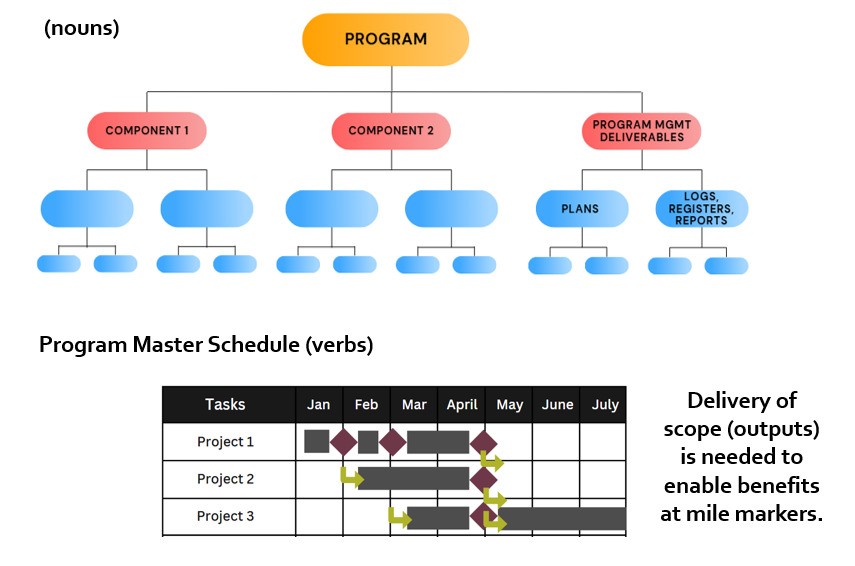
The work breakdown structure is one of the most important planning artifacts in program management, but building a good one (and continually iterating) requires understanding what drives it. The top-level branches of a program WBS are the program’s constituent components — its projects, subprograms, and program-level work. What determines which components are there, how they are grouped, and what they contain is the benefit chain that runs from organizational objectives through benefits, outcomes, capabilities, and outputs. The WBS gives that chain a manageable structure.
Benefit Logic
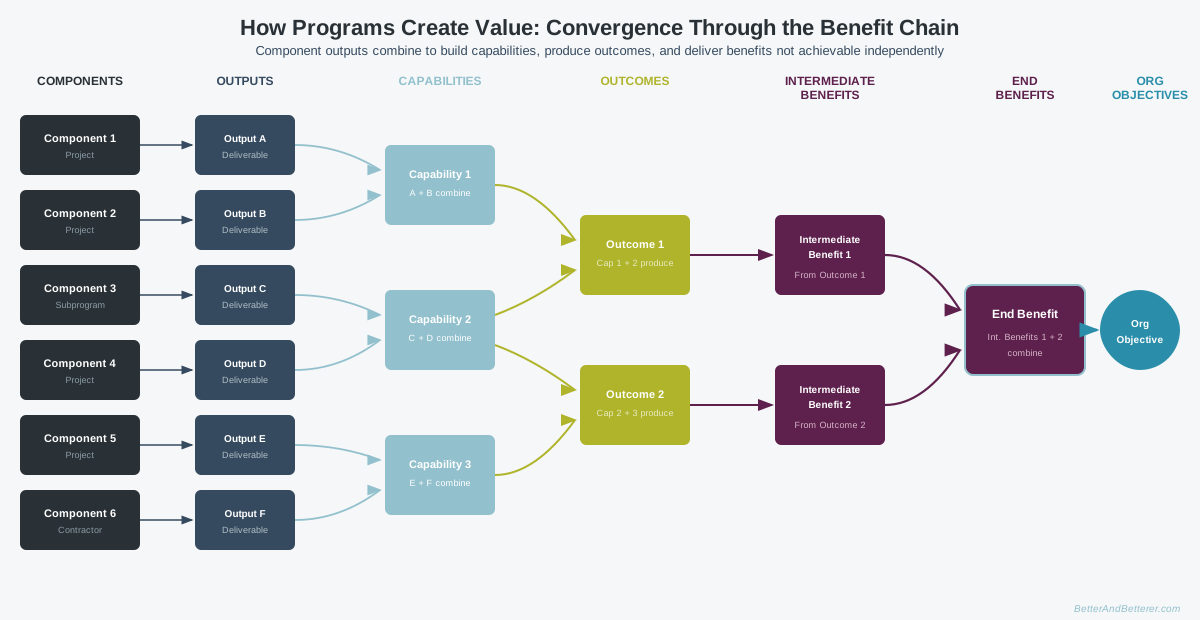
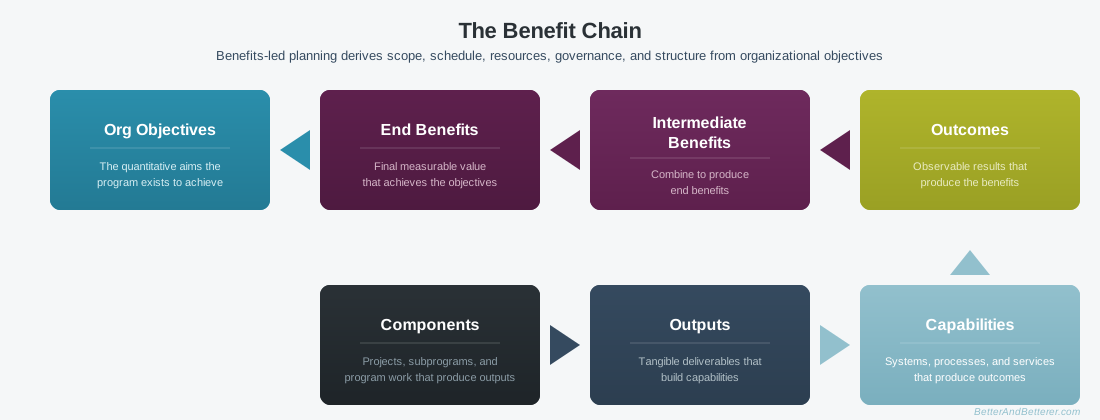
The scope that the WBS decomposes is derived from the program’s benefits structure. Organizational objectives define the quantitative aims the program exists to achieve. From there the logic works backward: what end benefits will achieve those objectives? What intermediate benefits combine to produce those end benefits? What outcomes (results) will produce those benefits? What capabilities (systems, processes, services) will produce those outcomes? What outputs (deliverables) will build those capabilities? And what components (projects, subprograms) will produce those outputs?
Org Objectives → Benefits (End Benefits → Intermediate Benefits) → Outcomes → Capabilities → Outputs → Components
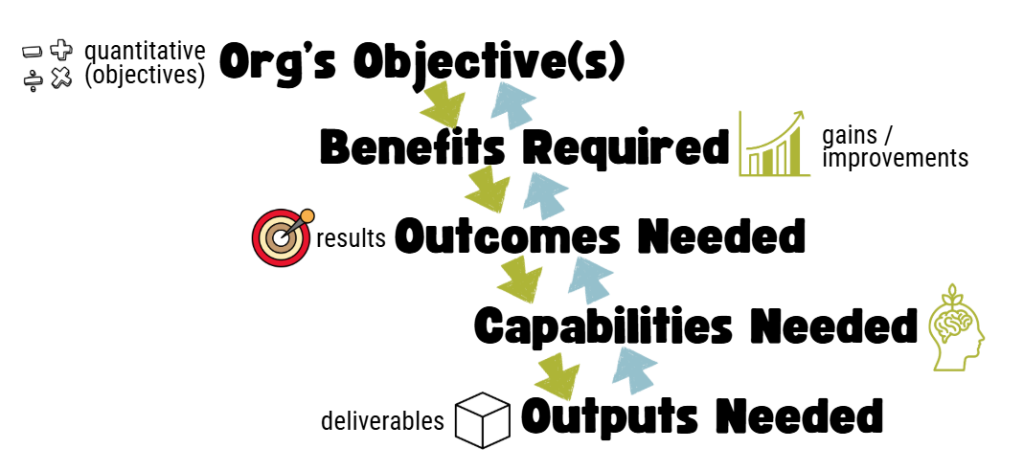
You’ll notice that the arrows go both ways. This keeps us strategically aligned. We can look at what happens from the bottom up (outputs >> org objectives) and see the actual synergies (and thus interdependencies) needed.
When Decomposing Your WBS, Think NOUNS
Each WBS element is named as a noun or noun phrase representing a tangible deliverable, result, or body of work. The WBS follows the 100 percent rule: each parent element is fully decomposed into child elements that represent 100 percent of that parent’s work and nothing outside it. No gaps, no overlap. This supports cost and schedule aggregation and provides a consistent basis for performance measurement across the program.
Decomposition at the Program Level
The program manager decomposes the program WBS only to the level needed to plan, coordinate, and control work across components. In most programs this means one or two levels beneath the top-level component branches — enough to identify major deliverables, assign ownership, establish cost accounts, and track dependencies between components. The program manager does not decompose into the detailed work packages that component project managers and subprogram managers will define within their own plans. Over-decomposition at the program level increases administrative burden, slows decision-making, and obscures the strategic view that the program manager needs to manage interdependencies and benefits delivery. The right depth is the depth at which the program manager can answer three questions: what is this component expected to deliver, when must it deliver it, and how does its work connect to the work of other components and to the benefit chain?
Don’t Forget Program Work!
A program WBS includes branches for program-level management, integration, benefits realization, and change activities — not just the branches representing projects and subprograms. Program work elements cover integration of component outputs, coordination of interfaces, benefit tracking, stakeholder engagement at the program level, and governance. Treating integration and interface work as explicit WBS elements rather than hidden overhead makes dependencies and coordination tasks visible and manageable.
Synergies of Benefits
Programs exist to deliver gains that could not be achieved by managing components independently. The synergies between components — shared resources, coordinated timing, interdependent outputs — are what justify managing them as a program. The benefit chain from organizational objectives through end and intermediate benefits, outcomes, capabilities, and outputs creates a time-phased model for when each result must be available. The WBS reflects this by grouping components and program work so that enabling capabilities and outputs appear in the structure in a way that supports their required synchronization. Schedules and cost baselines then align with benefit milestones rather than only with technical completion dates.
Integrated Control Points
A well-formed WBS acts as the backbone for cost breakdown structures, resource plans, and risk registers. Each WBS element maps to cost accounts, schedule activities, and risk items, allowing consistent roll-up and analysis. When cost classification systems or building information modeling data are available, the WBS can be aligned with those structures to sharpen scope definition. This alignment supports earned value analysis at the level of work packages and program work elements, using the WBS as the common reference.
Decomposition Guidelines for Your Component Managers and Contractors
Component project managers and subprogram managers decompose their assigned branches of the program WBS into the detailed work packages needed to plan, resource, schedule, and control their work. The program manager sets expectations for this decomposition: work packages should be small enough to estimate reliably, assign to a responsible owner, and monitor against completion criteria, but large enough to avoid excessive administrative overhead. Empirical threshold rules — such as limiting work packages to a manageable duration or effort range — help keep the structure usable in day-to-day management. The program manager communicates these expectations so that all components produce WBS structures that are compatible with the program’s cost, schedule, and performance measurement systems.
When contractors perform component work, the contract work breakdown structure (CWBS) is the mechanism that plugs contractor scope into the program WBS. The CWBS extends the program WBS into the contractor’s domain, decomposing the contracted deliverables and work to the level required by the contract and by the program’s earned value and reporting requirements. The CWBS must align with the program WBS at the interface points where contractor outputs feed into program-level deliverables and capabilities. This alignment gives the program manager visibility into contractor progress, cost performance, and schedule status using the same structure and measurement framework applied to internal components. Without a CWBS that maps to the program WBS, contractor work becomes a reporting gap — the program manager cannot trace contractor deliverables through the benefit chain or roll up contractor performance into the program’s integrated baseline.
Multidisciplinary Coherence and Interface Control
In complex programs, different engineering and organizational disciplines bring their own structuring templates, which can lead to duplicated work and hidden interfaces. A unified program WBS supported by a WBS dictionary and agreed terminology provides a common decomposition language. Dedicated interface and integration elements make cross-disciplinary dependencies visible — technical, contractual, and organizational. This supports consistent planning, buffer allocation, and configuration control across all components.
Don’t Hate, Iterate!
Initial WBS development uses the benefit chain and high-level component view to outline the major branches. As more information emerges about constraints, risks, and stakeholder expectations, the WBS and its dictionary evolve while preserving the benefit-driven logic. This iterative refinement maintains alignment between organizational objectives, benefits, capabilities, outputs, and components while adapting the structure to real-world constraints discovered during planning. The program WBS remains a living model that guides coordination of projects, subprograms, and program work toward the intended benefits.
The “Benefits-Led” Game of Program Management
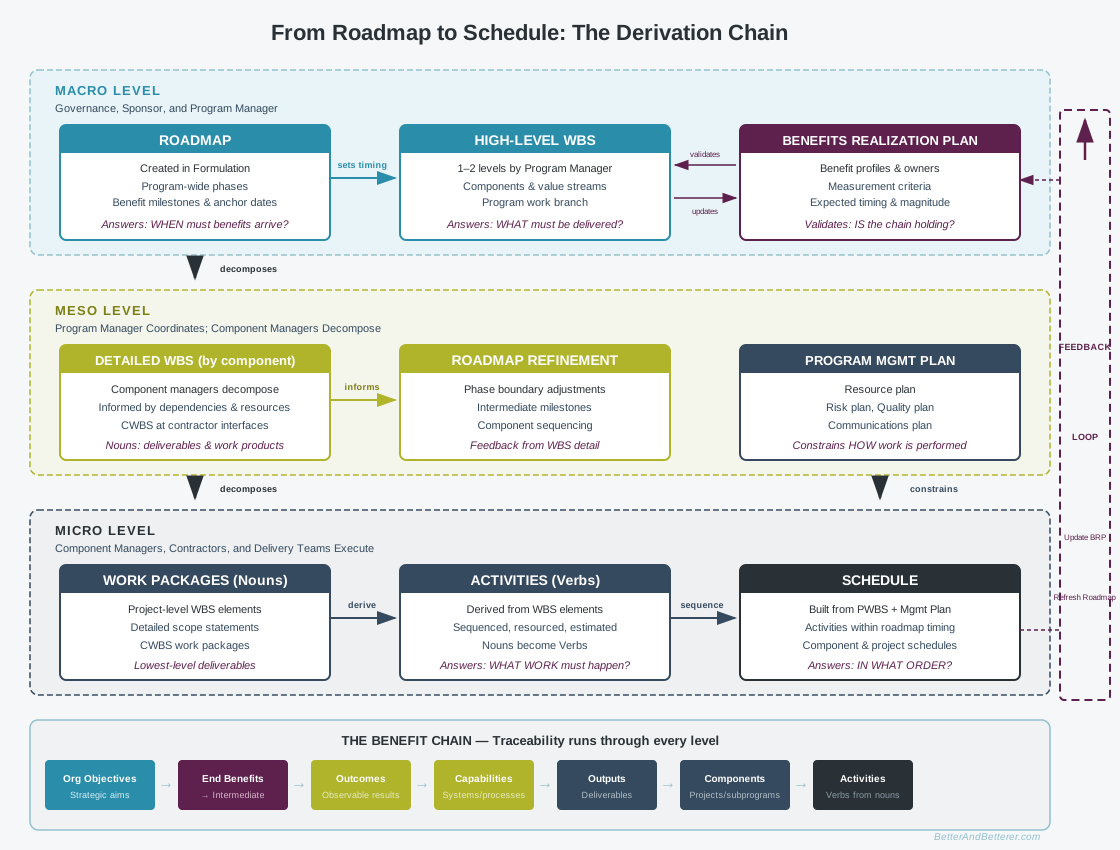
Programs exist to deliver gains that could not be achieved by managing components independently. The synergies between components — shared resources, coordinated timing, interdependent outputs — are what justify managing them as a program. The roadmap, WBS, and schedule each answer a different question about how those synergies are realized, and they form a derivation chain in which each artifact feeds the next.
The roadmap is created during formulation. It sets the program’s temporal architecture — program-wide phases, high-level benefits, and anchor milestones that tell governance and the sponsor when value will be delivered. The WBS is built during planning. It decomposes what must be delivered to hit those milestones, organized by components and derived from the benefit chain. The schedule is then built from the WBS. PMI states that the program schedule requires the program management plan and the program WBS as inputs. To build the schedule, the program team takes the WBS elements (nouns) and derives the activities (verbs) required to produce each deliverable. Those activities are sequenced, resourced, and time-estimated, then arranged within the timing constraints the roadmap establishes.
Roadmapping practice distinguishes between macro, meso, and micro levels of detail, and this derivation chain maps to that structure. At the macro level, the roadmap shows program-wide phases and benefit milestones while the high-level WBS outlines the main components and value streams required to reach those milestones — this is the governance and sponsor view. At the meso level, detailed WBS breakdowns for each component refine timelines, dependencies, and resource assumptions, supporting roadmap adjustments to phase boundaries and sequencing — this is the program manager and component leads’ view. At the micro level, project-level WBS packages and team plans drive activity-level schedules and fine-grained delivery commitments — this is the project managers’ and delivery teams’ view.
For more info see:
The derivation chain runs forward — roadmap to WBS to schedule — but the feedback loop runs backward. As WBS detail improves during planning, program teams test whether benefit timing and magnitude remain realistic given the defined work, dependencies, and capacity. When analysis of the WBS, scope statements, or early delivery data reveals slippage, new interdependencies, or learning, the program updates the benefits realization plan first, then refreshes the roadmap to show revised benefit waves, re-phased components, and any new enabling work. In predictive contexts these updates occur at structured planning gates and baseline reviews. In adaptive and hybrid contexts they follow a more frequent cadence — increment boundaries, program increment planning events, or timeboxed roadmap reviews — where teams use current WBS-like artifacts such as backlogs, feature maps, and epics alongside empirical benefit data to adjust the roadmap within the guardrails of the charter and business case.
The WBS sits at the pivot point of this architecture. It translates the roadmap’s strategic timing into a structured decomposition of deliverables, and it provides the scope foundation from which the schedule’s activities are derived. Every activity on the schedule traces back through its WBS element, through the benefit chain, to the roadmap milestone it serves. That traceability is what holds the macro, meso, and micro levels together as a single coherent planning architecture.
Conclusion
Program planning is benefits-led. Organizational objectives define the end benefits the program must deliver. Those end benefits require intermediate benefits that combine to produce them. Intermediate benefits require outcomes. Outcomes require capabilities. Capabilities require outputs. Outputs require components. The WBS organizes those components and their deliverables into a structure that can be planned, resourced, scheduled, and controlled — but the reason any component appears in that structure is because it produces something the benefit chain requires. The roadmap sets the macro timing for when those benefits must arrive. The WBS decomposes what must be delivered to meet that timing. Activities — the verbs — are derived from the WBS elements — the nouns — and sequenced into the schedule using the program management plan and the PWBS as inputs. When a program manager can trace any activity on the schedule back through its WBS element, through the benefit chain, to the organizational objective it serves, planning is grounded. When that traceability breaks, the program is doing work it cannot justify.
References
“Practice Standard for Work Breakdown Structures, 2nd Ed.” Project Management Institute
“A Guide to the Project Management Body of Knowledge (PMBOK® Guide), 6th Edition.” Project Management Institute
“NASA Work Breakdown Structure (WBS) Handbook.” National Aeronautics and Space Administration
“Integration of Cost and Work Breakdown Structures in the Management of Construction Projects.” A. Cerezo-Narváez, A. Pastor-Fernández, M. Otero-Mateo, P. Ballesteros-Pérez
“Features Of Implementing a Work Breakdown Structure in Multidisciplinary Projects.” V. Cretu
“Work Breakdown Structures for Projects, Programs, and Enterprises.” Gregory T. Haugan
“Work Breakdown Structure: Break Your Project into Manageable Units of Work.” Eric Verzuh
“Practice Standard for Work Breakdown Structures.” Project Management Institute