A program roadmap, a work breakdown structure, and a schedule each answer a different question. The roadmap answers when — when must benefits arrive, in what sequence, at what milestones. The WBS answers what — what deliverables must exist to produce those benefits. The schedule answers how and in what order — what activities must be performed, in what sequence, with what resources, to produce the deliverables the WBS defines within the timing the roadmap establishes. These three artifacts are not independent documents assembled in parallel. They form a derivation chain in which each artifact feeds the next, and each operates at a different level of detail.
The Chronological Logic
The roadmap is created during the formulation subphase. It is one of the three formulation artifacts alongside the business case and the program charter. PMI describes it as a high-level chronological representation linking business strategy to program work, showing benefits delivery within major stages and milestones. The roadmap sets the program’s temporal architecture: it tells governance and the sponsor when the program expects to deliver value, and in what phases.
The WBS is built during planning. Its elements are nouns — deliverables, work products, components — derived from the benefit chain that runs from organizational objectives through end benefits, intermediate benefits, outcomes, capabilities, outputs, and components. The WBS translates the roadmap’s strategic intent into a structured decomposition of everything the program must deliver. Its top-level branches are the program’s constituent components and its program-level management work. Below that, decomposition continues only to the level needed for the program manager to plan, assign, and monitor the work.
The schedule is then built from the WBS. PMI states that the program schedule is developed from the program management plan and the program WBS. To build the schedule, the program team takes the WBS elements (nouns) and derives the activities (verbs) required to produce each deliverable. Those activities are sequenced, resourced, and time-estimated, then arranged within the timing constraints the roadmap establishes. The schedule bridges the roadmap’s strategic timing and the WBS’s scope architecture by sequencing the work that must happen to produce the deliverables at the milestones where they are expected.
The derivation chain runs in one direction: roadmap → WBS → schedule. The roadmap precedes and constrains the WBS. The WBS precedes and feeds the schedule. Each artifact answers a different question at a different level of detail, but they are linked by the benefit chain that justifies the program’s existence.
Macro, Meso, and Micro Levels
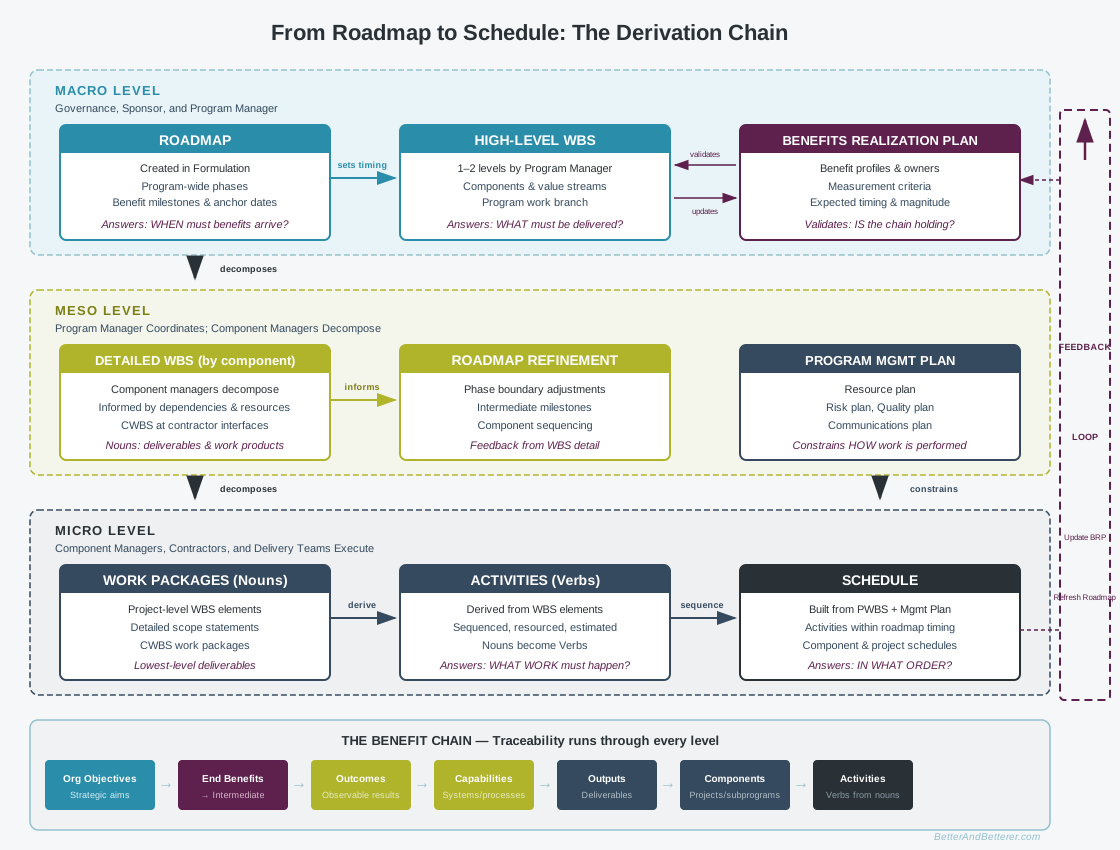
Roadmapping practice distinguishes between macro, meso, and micro levels of detail, and the derivation chain maps cleanly to this structure.
At the macro level, the roadmap shows program-wide phases, high-level benefits, and anchor milestones that matter to the sponsor and portfolio governance. The high-level WBS outlines the main components and value streams required to reach those milestones. This is the governance and sponsor view: it connects the program’s strategic intent to its structural composition. The scope statements, benefits realization plan, and high-level WBS together translate the roadmap’s strategic timing into a coherent picture of what the program must deliver and when.
At the meso level, more detailed WBS breakdowns for each component refine timelines, dependencies, and resource assumptions. The roadmap at this level depicts streams or component groups and their key releases or transitions. This is the program manager and component leads’ view: it supports planning decisions about phase boundaries, intermediate milestones, and sequencing. Detailed WBS decomposition within components reveals interdependencies and resource demands that may require adjustments to the roadmap’s phase structure.
At the micro level, project-level WBS packages, detailed scope statements, and team plans inform fine-grained delivery commitments. Activities (verbs) are derived from the lowest-level WBS elements (nouns) and sequenced into project schedules. This is the project managers’ and delivery teams’ view: it drives day-to-day execution and surfaces feasibility constraints or opportunities that may warrant refinements to the meso- or macro-level plans.
A single architecture that integrates these three levels supports alignment across executive, middle management, and delivery teams, while allowing each group to view the detail relevant to their decisions. The macro level sets strategic constraints. The meso level translates those constraints into component-level plans. The micro level executes within those plans and feeds information back up.
The Iterative Loop
The derivation chain runs from roadmap to WBS to schedule, but the feedback loop runs in the other direction. As planning progresses and WBS detail improves, program teams test whether benefit timing and magnitude remain realistic given the defined work, dependencies, and capacity. When analysis of the WBS, scope statements, or early delivery data reveals slippage, new interdependencies, or learning, the program updates the benefits realization plan first, then refreshes the roadmap to show revised benefit waves, re-phased components, and any new enabling work.
The benefits realization plan interacts iteratively with the roadmap and WBS to keep the program aligned with value delivery. Initial versions of the plan define benefit profiles, owners, measurement approaches, and expected timing, which the roadmap reflects as benefit milestones and transition points. As WBS detail improves, the program can validate whether the benefit chain’s logic holds: do the planned outputs actually build the capabilities needed to produce the outcomes that generate the benefits at the milestones where they are expected?
In predictive contexts, these updates typically occur at structured planning gates and baseline reviews, when significant changes to WBS structure, scope, or benefit profiles justify a roadmap revision. In adaptive and hybrid contexts, updates follow a more frequent cadence — increment boundaries, program increment planning events, or timeboxed roadmap reviews — where teams use current WBS-like artifacts (backlogs, feature maps, epics) and empirical benefit data to adjust the roadmap within the guardrails of the charter and business case.
Nouns to Verbs: The WBS-to-Schedule Bridge
The transition from WBS to schedule is the transition from nouns to verbs. WBS elements name what must exist: a deliverable, a capability, a work product. To build the schedule, the program team asks: what activities must be performed to produce this deliverable? Each WBS element generates one or more activities. Those activities are sequenced based on dependencies (logical relationships between activities), resourced based on availability and capacity, and time-estimated based on complexity and effort.
PMI states that building the schedule requires the program management plan and the program WBS. The management plan provides the subsidiary plans (resource, risk, quality, communications) that constrain how work is performed. The WBS provides the scope architecture that defines what work exists. Together, they produce a schedule that is traceable from every activity back through its WBS element, through the benefit chain, to the organizational objective it serves.
This traceability is the derivation chain’s value. When a schedule activity slips, the program manager can trace the impact upward: which WBS deliverable is affected? Which capability does that deliverable support? Which outcome depends on that capability? Which benefit is at risk? Which roadmap milestone may need to move? The derivation chain makes it possible to assess the benefit impact of operational problems and the operational implications of strategic decisions.
The Complete Picture
The roadmap is created during formulation and sets the macro timing — when benefits must arrive. The WBS is built during planning and decomposes what must be delivered, organized by components and derived from the benefit chain. Activities are derived from WBS elements — nouns become verbs — and sequenced into the schedule using the program management plan and PWBS as inputs. The benefits realization plan interacts iteratively with all three artifacts to validate that the program’s work, timing, and structure remain aligned with the benefits that justify its existence.
Across macro, meso, and micro levels, this architecture gives governance the strategic view, program management the coordination view, and delivery teams the execution view — all derived from the same benefit chain, all traceable to the same organizational objectives, and all connected through a derivation chain that translates strategic intent into operational work.