ITIL v5 Foundations Quiz
Test your knowledge of service relationships, governance, and guiding principles!
ITIL v5 Study Tips: Service Relationships, Governance & Guiding Principles
Minor (Yet Important) Updates to a Couple Key Terms 📊Know These Come Test Day
Digital Product and Service Management
A set of specialized organizational capabilities for enabling value for customers in the form of digital products and services.
ITIL Value System (VS)
A model representing how all the components and activities of an organization work together to facilitate value creation through digital products and services.
1. Service Relationships – The Three Types 📊Know These Come Test Day
BASIC Relationships = OPERATIONAL only
- Think: Broad reach, standardized
- Examples: Mobile operators, broadband providers, cloud storage
- One-size-fits-most approach
- Remember: If it’s for the masses with no customization → Basic
COOPERATIVE Relationships = OPERATIONAL + TACTICAL
- Think: Customized for you
- Examples: Managed service providers, shared services in large orgs
- Tailored to specific customer requirements
- Remember: If it’s customized but not strategic → Cooperative
COLLABORATIVE Relationships (Partnerships) = OPERATIONAL + TACTICAL + STRATEGIC
- Think: Complete partnership, all levels
- Examples: Internal IT teams, external providers with shared goals
- High trust, shared dependencies and goals
- Remember: If it involves shared strategic goals → Collaborative
⚠️ Misalignment = Dissatisfaction Both provider and consumer MUST aim for the same relationship type, or misunderstandings will occur!
2. The Band of Visibility
🔑 Definition 📊Know This Come Test Day
“The sum of the aspects of the service consumer organizations visible to the service provider, and the aspects of the service provider organizations visible to the service consumer.”
Basic:        [narrow band]     - See very little of each other
Cooperative:  [medium band]     - See more operational details
Collaborative: [wide band]      - See nearly everything, all levels
Study Tip: The closer the relationship, the wider the visibility. Think of it as transparency increasing with trust.
3. The Service Journey – 7 Steps
The 7 Steps in Order
- Explore – Before formal relationship exists; assess needs & capabilities
- Engage – Build relationships & ties between parties
- Offer – Shape demand into business case; match requirements with supply
- Agree – Align expectations, scope, quality; get ready to commit
- Onboard – Commit or exit; integrate or separate resources
- Co-create – Use services actively; work jointly to generate value
- Reflect – Review value; identify improvements; adjust funding
📝 The Key Players for Each
- Explore/Engage: Customers, sponsors, users
- Offer/Agree: Add buyers, legal specialists
- Onboard/Co-create: Focus on users and customers
- Reflect: Users, customers, sponsors
4. Service Quality vs. Service Levels
🔑 Key Distinction
- Service Quality = Characteristics and outcomes (the WHAT)
- Service Levels = Measurable metrics that define quality (the HOW WE MEASURE)
Remember: Quality → Metrics → Service Levels
Quality expectations are translated into metrics which define the service level.
5. Four Categories of Service Level Metrics
The Four Categories 📊Know These Come Test Day
- Utility – What the service does; fit for purpose
- Warranty – How it performs; availability, capacity, security
- Sustainability – Environmental, social, economic responsibility
- User Experience (UX) – Functional and emotional interactions
⚠️ NO category is more important than another! Don’t assume focusing on one (like experience) means the others will “take care of themselves.” They won’t.
📋 SLA Coverage
Every SLA should cover ALL FOUR categories:
- Utility ✓
- Warranty ✓
- Sustainability ✓
- User Experience ✓ (when services are consumed by users)
6. Sustainability – What It Covers
🔑 The Three Pillars
- Environmental stewardship
- Social progress
- Economic growth
Examples to Remember
- Responsible sourcing
- Clean energy use
- Low carbon footprint
- Recyclable materials
- Transparent supply chains
Study Tip: Often guided by regulations or organizational strategy
7. User Experience (UX) Factors
🔑 What Leads to Positive UX
- Ease of use
- Attractiveness of interface
- Relevance to customer/user objectives
- Access to support when needed
- Value perception
- Acquiring the service is easy
8. The ITIL Value System (VS) 📊Know These Come Test Day
🔑 Five Components
- Guiding Principles
- Value Chain
- Practices
- Continual Improvement
- Governance
Be sure to take a look at the ITIL VS model (it looks the same as ITIL 4 SVS)
INPUT: Opportunity & Demand
    ↓
[ITIL Value System]
    ↓
OUTPUT: Value (outcomes for customers & stakeholders)
⚠️ Important Distinction
- Management System = HOW work is done (GPs, value chain, practices. CI)
- Governance = OVERSIGHT ensuring it’s done responsibly
9. Governance and the EDM Cycle
🔑 What is Governance?
“The system by which an organization is directed and controlled.”
The EDM Cycle
- Engage – Involve stakeholders; clarify needs & accountability <== newly added
- Evaluate – Assess strategies, portfolios, policies, relationships
- Direct – Prepare strategies/policies; assign responsibilities
- Monitor – Check performance & compliance
📊 Flow
Engage → Evaluate → Direct → Monitor → [feeds back to next Evaluate]
Study Tip: EDM is CYCLICAL – monitoring feeds back into the next evaluation round!
Engage stakeholders: to identify needs, clarify commitments, and agree on accountability for technology use.
Evaluate: the current state of the organization, its strategies, portfolios, policies, relationships, and so on.
Direct: during direction, policies and strategies are established and modified.
Monitor: with policies and strategies in place, the governing body now monitors performance and compliance.
Who Does It?
- Governing Body = Board of directors or senior executives (in governance role)
- They ensure performance AND compliance; They are accountable, at the highest level, for the performance and compliance of the organization
ITIL v5 calls out:
- Governance of digital technology:
A governance system focused on the current and future use of digital technology.
Comprises:
- Directing
- Overseeing
- Accountability
10. Guiding Principle: Start Where You Are 📊Know These Come Test Day
🔑 Core message of each GP is the same as we saw in v4 with some fun new info to chew on…
The seven ITIL Guiding Principles are universal and enduring, and Axelos has proven this by keeping these 7 the same as the ones we saw in ITIL 4. 🙂
In ITIL v5, each has been updated with AI integration and some principles mention new tools.
GP #1: Focus on Value
Core Message: Everything the organization does should link back to value for itself, customers, and stakeholders.
Key Concepts:
- Value is co-created between provider and consumer
- Understand who the service consumer is (customer, user, sponsor)
- Know what they consider valuable
- Focus on outcomes, not just outputs
AI’s Role:
- Real-time analysis and predictive insights
- Anticipate customer needs before they arise
- Align services more closely with expectations
- Improve customer satisfaction through data-driven decisions
What This Means in Practice:
- Every service, product, or action should deliver value
- Regularly verify that stakeholders’ definition of value hasn’t changed
- Use AI to leverage real-time data and anticipate needs
GP #2: Start Where You Are
Core Message: Don’t discard existing capabilities! Build on what works.
DO:
- ✓ Directly observe and measure current state
- ✓ Use ITIL Practice Guides and Maturity Model for assessment
- ✓ Ask “stupid” questions – they uncover insights!
- ✓ Involve fresh eyes (people with no prior knowledge)
- ✓ Look for what’s fit for purpose AND fit for use
- ✓ Leverage AI-driven analytics for unbiased baseline
- ✓ Apply risk management when reusing practices
DON’T:
- ✗ Start from scratch (rarely wise, often wasteful)
- ✗ Rely only on reports (they can be biased)
- ✗ Assume everything is broken
- ✗ Discard existing methods just because you’re “improving”
AI’s Role:
- Provide unbiased baseline of service performance
- Identify realistic improvement opportunities
- Help avoid discarding valuable resources unnecessarily
Exception to Know: Rare cases exist where nothing can be reused and you must start over – but this should be the EXCEPTION, not the rule!
GP #3: Progress Iteratively with Feedback
Core Message: Feedback must be continuous and built into every iteration!
When to Collect Feedback:
- Before each iteration
- During each iteration
- After each iteration
Why? Circumstances change! No iteration occurs in a vacuum.
The Feedback Quadrants ⭐ NEW
Feedback can be categorized across two dimensions, creating four quadrants:
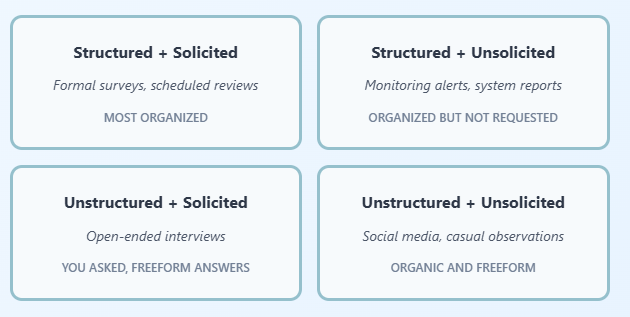
The Four Quadrants:
- Structured + Solicited
- Example: Formal surveys, scheduled reviews
- Most organized and intentional
- Structured + Unsolicited
- Example: Automated monitoring alerts, system-generated reports
- Organized but not specifically requested
- Unstructured + Solicited
- Example: Open-ended interview questions, “Tell us what you think”
- You asked, but answers are freeform
- Unstructured + Unsolicited
- Example: Social media comments, casual user observations
- Organic and freeform
All four types are valuable and should be captured and analyzed!
Types of Feedback to Gather:
- Customer perception of value
- Efficiency and effectiveness
- Governance quality
- Supplier interfaces
- Changes in demand
What to Do: Analyze all feedback to reveal improvements, risks, and issues
AI’s Role:
- Process continuous feedback across all quadrants
- Analyze real-time performance metrics
- Identify trends, issues, and bottlenecks
- Support timely adjustments
- Enable incremental improvements
GP #4: Collaborate and Promote Visibility
Core Message: Without visibility, decisions suffer and improvements stall. Transparency is essential to engagement and progress.
Why It Matters:
- Value cannot be delivered in silos
- Insufficient visibility leads to poor decision-making
- Organizations can’t identify which improvements will have the greatest impact
Who to Involve:
- Customers – Most important; organization’s main goal is delivering outcomes for them
- Suppliers – Help define requirements and design solutions
- Relationship managers – Ensure full understanding of consumer needs
- Internal and external teams – Review workflows, identify bottlenecks
- Product teams – Collaborate with IT operations, SRE, and user support across lifecycle
Critical Analysis Activities:
- Understanding the flow of work in progress
- Identifying bottlenecks AND excess capacity
- Uncovering waste
Tools for Visibility:
- Dashboards
- Kanban boards
- Other transparency tools to show progress to stakeholders
AI’s Role:
- AI-powered collaboration platforms enhance visibility
- Natural language processing and machine learning highlight insights
- Proactively surface relevant updates and risks
- Break down silos
- Make it easier for teams to share knowledge and collaborate effectively
GP #5: Think and Work Holistically
Core Message: No product, service, practice, process, team, or supplier stands alone. Value delivery requires integration, not silos.
What Holistic Thinking Means:
- End-to-end visibility of how demand becomes outcomes
- Recognizing that changes in one area affect the whole system
- Considering all four dimensions of service management
- Looking across the full lifecycle of products and services
- Understanding the organization’s place in the wider supply chain
- Managing impacts on service consumers
- Continually monitoring external PESTLE factors
Key Insight: “Outputs will suffer unless the organization works in an integrated way and treats activities as a whole rather than in isolation.”
How to Apply:
- Recognize the complexity of systems
- Different complexity levels require different approaches
- Methods for simple systems won’t work in complex ones
- Collaboration is key
- Right mechanisms enable timely stakeholder collaboration
- Address issues holistically without delays
- Look for patterns in interactions
- Use knowledge from across the system
- Identify what’s essential for success
- Anticipate needs and set standards
- Use automation and AI
- Provide end-to-end visibility
- Analyze complex interactions
- Support integrated, holistic management
AI’s Role:
- Provides end-to-end visibility across the system
- Analyzes complex interactions and dependencies
- Identifies patterns that humans might miss
- Supports integrated, holistic decision-making
GP #6: Keep It Simple and Practical
Core Message: Focus on outcomes, not covering every possible exception. Simplicity means minimizing steps and using outcome-based thinking.
Key Principle: If a process, product, service, action, or metric does not add value, it should be eliminated.
Handling Exceptions:
- Don’t try to solve for every exception – This leads to over-complication
- Use enabling constraints instead of fixed rules:
- Guiding principles
- Autonomy
- Trust
- Adequate resources
Why Enabling Constraints Work Better:
- Fixed constraints rarely work in high-complexity situations
- Enabling constraints allow teams to handle exceptions generally
- They keep processes simple while maintaining effectiveness
Maintaining Balance:
- Take a holistic view
- What looks unnecessary to one team may be essential for:
- Regulatory compliance
- Corporate needs
- Other stakeholder requirements
For Products and Services:
- Focus on features that maximize value
- Avoid the “build trap” of adding unnecessary complexity
- Stay focused on value to keep offerings simple and practical
Managing Conflicting Objectives ⭐ NEW CONCEPT
Common Example: Balancing decision-making data needs vs. record-keeping effort
The Reality: Conflicting objectives are common in organizations
The Goal: Not to eliminate one side, but find the balance that maximizes value
Solution Approach:
- Only generate data that truly provides value to decision-making
- Simplify and automate record-keeping where possible
- Maximize value while reducing non-value-adding work
AI’s Role:
- Identify inefficiencies in workflows
- Streamline processes by automating repetitive tasks
- Free staff to focus on more strategic activities
- Help balance conflicting objectives through data analysis
GP #7: Optimize and Automate
Core Message: Optimization comes FIRST. Automation should never be applied to poor processes.
What Optimization Means:
- Making something effective, efficient, and useful
- Working within real-world constraints: cost, compliance, time, resources
- Getting the greatest value from both human and technical resources
Critical Sequence:
- First: Optimize the process
- Then: Automate it (if appropriate)
Governance Requirements:
- Automation must enhance, not replace, good practices
- Subject to governance and ethical controls
- Especially important when using generative AI
- Must not introduce unnecessary risks or reduce organizational resilience
The Goal: Free people to focus on higher-value decision-making while ensuring technology adds value safely
The Optimization Roadmap (6 Steps)
Optimization is a journey, not a one-time task:
- Agree the context, vision, and objectives
- Get clarity on what you’re trying to achieve
- Assess the current state
- Identify improvement opportunities with the greatest impact
- Define the future state and priorities
- Focus on simplification, value, and standardization
- Support later automation
- Ensure stakeholder engagement and commitment
- Secure buy-in from those affected
- Execute improvements iteratively
- Use metrics and feedback to stay on track
- Adjust as needed
- Continually monitor results
- Uncover further opportunities for improvement
- Keep the cycle going
Automation vs. AI ⭐ KEY DISTINCTION
Automation:
- Uses technology to perform steps correctly and consistently
- Requires little or no human involvement
- Ranges from streamlining manual tasks to continuous deployment
- Benefits: Reduces costs, errors, and manual effort; improves employee experience
AI:
- Extends automation with intelligence and adaptability
- Includes: Co-pilots, data insights, chatbots, intelligent workflows
- Adds powerful capabilities beyond basic automation
- Requires strong governance for quality, ethics, privacy, and security
How to Apply This Principle
Steps:
- First simplify and streamline workflows before automating
- Define outcome-based metrics to measure improvements and value
- Build on other guiding principles:
- Progress iteratively
- Keep it simple
- Focus on value
- Use what already exists
AI’s Enhanced Role:
- Intelligent monitoring
- Process optimization
- Error reduction
- Pattern recognition
Governance Essentials (especially for AI):
- Sustainability
- Ethics
- Privacy
- Security
Remember: While AI can enhance automation significantly, it must remain under strong governance to ensure it delivers value responsibly.
Quick Summary: The 7 Guiding Principles
Optimize and Automate – Optimize first, then automate; AI enhances with strong governance
Focus on Value – Everything links to value; AI enables predictive insights
Start Where You Are – Build on existing capabilities; AI provides unbiased baseline
Progress Iteratively with Feedback – Continuous feedback across 4 quadrants; AI processes and analyzes
Collaborate and Promote Visibility – Transparency prevents poor decisions; AI breaks down silos
Think and Work Holistically – Integrate across the system; AI provides end-to-end visibility
Keep It Simple and Practical – Eliminate non-value work; balance conflicting objectives; AI streamlines
Quick Reference Tables
Service Relationship Types
| Type | Levels | Example | Key Feature |
|---|---|---|---|
| Basic | Operational | Mobile carriers | Standardized, wide audience |
| Cooperative | Operational + Tactical | Managed services | Customized to requirements |
| Collaborative | All three levels | Internal IT partnerships | Shared goals & trust |
Service Journey Steps & Key Players
| Step | Focus | Who’s Involved |
|---|---|---|
| Explore | Assess needs | Customers, sponsors, users |
| Engage | Build relationships | Customers, buyers, sponsors |
| Offer | Shape business case | + Legal specialists |
| Agree | Align expectations | Customers, buyers, sponsors |
| Onboard | Commit/integrate | Customers, users |
| Co-create | Generate value | Users, customers |
| Reflect | Review & improve | Users, customers, sponsors |
Service Level Metric Categories — Know These!!!
| Category | Definition | Example Metrics |
|---|---|---|
| Utility | The functionality offered by a product or a service: ‘what’ the service does; ‘fit for purpose’; a service must either support the performance of the consumer or remove constraints from the consumer, and many services do both | Functionality, features |
| Warranty | Assurance that a product or service will meet agreed requirements: ‘how’ the service performs ‘fit for use’; often relates to service levels aligned with the needs of service consumers; typically addresses areas such as the availability of the service, its capacity, levels of security, and continuity | Availability, capacity, security |
| Sustainability | The assurance that a product or service meets and will continue to meet the requirements for environmental stewardship, social progress, and economic growth. | Carbon footprint, clean energy |
| User Experience (UX) | The sum of the functional and emotional interactions with a service and service provider as perceived by a service user. | Ease of use, interface quality |
Definitions 📊Also Know These Come Test Day
Service quality:
The sum of the characteristics of a service that are relevant to its ability to satisfy stated and implied needs.
Service level:
A set of metrics that define expected or achieved service quality.
Sustainability:
The assurance that a product or service meets and will continue to meet the requirements for environmental stewardship, social progress, and economic growth.
User experience (UX):
The sum of the functional and emotional interactions with a service and service provider as perceived by a service user.
Service Level Agreement (SLA):
A documented agreement between a service provider and a customer that identifies the services provided and the agreed level of each service.
SLA Key Considerations:
- Formality, scope, and customization of SLA depend on service type and relationship.
- Digital service SLAs should cover: utility, warranty, sustainability.
- For user-facing services, include user experience metrics.
Service value = utility + warranty + sustainability + experience
Management system:
A system of interconnected elements that establish policy and objectives and enable the achievement of those objectives.
Elements of an org’s product and service management system indlude:
- Guiding principles: universal recommendations for decisions and actions.
- Value chain: interconnected activities that create and deliver products and services.
- Management practices: sets of organizational capabilities designed for accomplishing specific objectives.
- Continual improvement: recurring activity at all organizational levels to ensure that the organization continually meets stakeholders’ expectations.
Tips
✅ Understand the three relationship types: Basic, Cooperative, Collaborative (be able to spot and describe them)
✅ Remember that we now have service journey steps: Explore, Engage, Offer, Agree, Onboard, Co-create, Reflect (though it doesn’t seem we need to memorize these, phweew!)
✅ Know all four service level categories: Utility, Warranty, Sustainability, Experience; SLAs cover all four categories when appropriate
✅ Know the five Value System components: Guiding Principles, Value Chain, Practices, Continual Improvement, Governance… Q: The concept of the ______ describes these 5. (Ans. ITIL Value System)
✅ Understand the EDM cycle: Engage, Evaluate, Direct, Monitor
✅ Remember misalignment causes dissatisfaction in service relationships!
✅ Remember AI’s expanding role across all Guiding Principles
✅ Governance completes the Value System but isn’t part of the management system (management needs to abide by the controls set by governance, etc.)
✅ And don’t forget, I am writing to cover the NEW stuff! You still need to know the service consumer types (customer, user, sponsor) and how to spot those; You still need to know the 4D’s and how to spot those (though now there are new tools/concepts that map to these as well); You still need to know the key vocabulary terms (event, incident, problem, known error, and the list goes on and on.
Good luck with your studies! 🎯
🎓 ITIL v5 Flashcard Quiz
Loading…
👆 Click card to reveal answer
👆 Click card to see question